

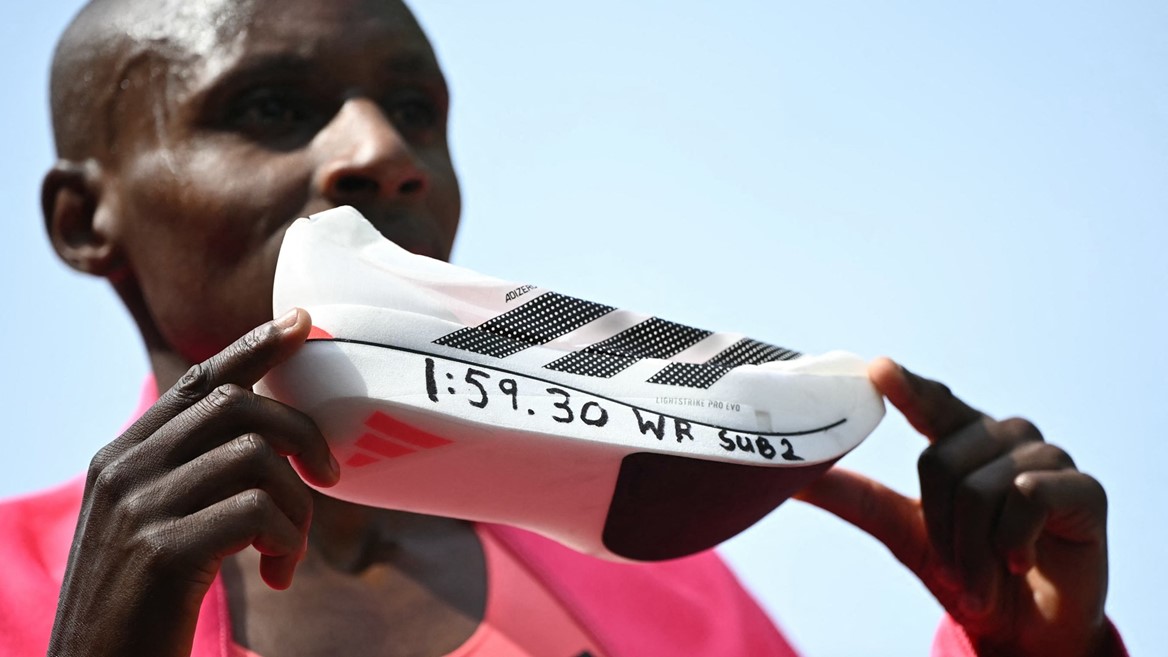
Adidas shares climbed on Monday after three athletes wearing the sportswear giant’s latest running shoe delivered record-breaking performances at the London Marathon.
Shares in Adidas rose by almost two per cent in early afternoon trading in Frankfurt, before paring gains to trade 1.4 per cent higher at €138 (£119) a share.
The uplift came after Kenya’s Sabastian Sawe became the first man to run a marathon in under two hours in an official race, setting a new world record of 1:59:30 at Sunday’s London Marathon.
Ethiopia’s Yomif Kejelcha finished just behind him in 1:59:41, while fellow Ethiopian Tigist Assefa set a women-only world record of 2:15:41.
All three athletes were wearing the new Adidas Adizero Adios Pro Evo 3, the lightest shoe in the brand’s Adizero range, weighing an average of 97 grams. The shoe, which launched in a limited release on 23 April, is priced at $500 a pair.
The race results delivered a high-profile performance win for Adidas as it looks to strengthen its position in the running category, amid fierce competition from Nike and other sportswear rivals.
Deutsche Bank analyst Adam Cochrane told CNN that the London Marathon results were significant for Adidas “given the visibility and popularity of running”.
“For Adidas, this provides an important milestone for a successful rebuild of their running franchise,” he said.
Cochrane added that the marathon “will cement the sporting credibility of Adidas in an important and growing category”.
“The London Marathon wins highlight the research and development work put in by Adidas over a number of years,” he said. “The key will be taking the marketing boost… and transferring this into customer demand amongst club and casual runners.”
The results come as Adidas continues to rebuild momentum following several challenging years, including financial pressure linked to the end of its Yeezy collaboration with Kanye West, who now goes by Ye.
The brand has since benefited from strong demand for lifestyle trainers including Samba and Gazelle, while its latest running performance provides a further boost to its sporting credentials.
Sawe’s time beat the previous official men’s marathon world record held by the late Kenyan athlete Kelvin Kiptum, who ran 2:00:35 at the Chicago Marathon in 2023.
In 2019, Eliud Kipchoge became the first man to run a marathon in under two hours while wearing Nike trainers, although the achievement did not count as an official record because it took place under controlled conditions.
Adidas Running general manager Patrick Nava said: “The Adidas family is incredibly proud of Sabastian and Tigist’s historic achievements, marking the fastest times humans have ever run in a marathon.
“This is a testament to the years of hard work and dedication they have made, alongside our innovation team.”
GlobalData lead apparel analyst Louise Deglise-Favre said Adidas had continued its “upwards trajectory” in 2026, with net revenue rising 7.1 per cent to €6.6bn in its first quarter.
Currency-neutral sales increased 14 per cent, while operating profit rose 15.6 per cent to €705m, pushing its operating margin up 0.8 percentage points to 10.7 per cent.
Deglise-Favre said the strong quarter had led Adidas to reiterate its full-year guidance, despite an expected €400m impact from currency movements and US tariffs.
“Footwear currency-neutral sales rose four per cent, driven by double digit growth in its running, training and football ranges,” she said.
“In particular, the Adizero range continued to perform well and will undoubtedly continue to appeal to shoppers now that one of its models helped Sabastian Sawe and Yomif Kejelcha break the marathon record by running the London Marathon in under two hours this past weekend.”
She added that Adidas’ Originals lines had remained in demand, with ballet and Mary Jane-inspired profiles gaining traction, while the company continued to drive repeat purchases through new iterations and colourways.
However, apparel continued to outperform footwear, with currency-neutral sales rising 31 per cent, helped by strong demand for Adidas Originals clothing.
Deglise-Favre said the brand’s strategy of tailoring product ranges by region had “clearly paid off”, with direct-to-consumer sales rising 22 per cent on a currency-neutral basis.
Europe remained Adidas’ largest region but recorded the slowest growth, with currency-neutral sales up six per cent, while North America rose 12 per cent despite tighter control on wholesale supply.
Greater China delivered currency-neutral growth of 17 per cent, Emerging Markets rose 10 per cent, Latin America increased 26 per cent, and Japan and South Korea grew 23 per cent.
Click here to sign up to Retail Gazette‘s free daily email newsletter