


Stores are rapidly evolving into full-fledged media channels, as retailers double down on retail media network (RMN) investments. The transformation is being fuelled by growing demand for the ad channel, with 65 per cent of global marketers projected to incorporate retail media into their planning mix in the next year.
But as excitement for the medium builds, so does the complexity of the infrastructure behind it. Connecting in-store screens, smart shelves and data-driven advertising to broader RMN strategies brings unique technological, operational, and data-related challenges. One of the first questions retailers often face as they dive in is, build or buy?
 Building a network from the ground up enables more intuitive customisation, greater scalability, and futureproofing. On the other hand, deploying an off-the-shelf solution can be faster and easier. Making the right decision requires careful examination of the advantages, tradeoffs, and OPEX of each path to determine which best aligns with your long-term retail media strategy. As more retailers are finding, hybrid architecture is on the rise, which may just be the best fit yet.
Risks versus benefits
With in-store advertising quickly becoming a larger retail media networks consideration, it’s easy to feel pressured to launch a network fast. An all-in-one option may require less upfront technical and team resources, but it also often comes with hidden OPEX costs and long contracts that can be difficult to navigate and hamper long-term gains. As you evaluate your options, it’s important to consider whether a fixed solutions provider has your best interests in mind. Are they listening to your needs or pushing their own agenda, without providing the flexibility you need to achieve your RMN goals and evolve with market shifts?
Many retailers who initially opted for this path are now running into limitations, as most off-the-shelf solutions currently only support fairly generic content and ads that run on a loop at set times, also known as static looped content. Engaging shoppers with more dynamic, personalised content that’s timely and relevant to them is where in-store shines, so lacking this ability is a huge miss. Retailers can achieve a more robust and custom in-store media network by building it from scratch, but that typically requires substantial upfront resources and can be difficult to scale quickly.
However, a hybrid architecture or modular approach offers the best of both worlds. In this case, a retailer assembles a custom tech stack of third-party solutions that manage some of the heavy network operations and maintenance lifting. Once a network backbone is established, they can then plug in the best solutions to meet their goals and manage network elements, from audio to RMN platforms, content management, owned communications, programmatic revenue, and beyond.

While this approach may be more time-consuming in the short term than adopting an all-in-one solution, it’s much faster than building entirely from scratch and lets retailers maintain full network control with no long-term contract commitments. Solutions that offer flexibility, customisation, ownership, and plug-and-play integration into the network backbone are ideal for maximum effectiveness.
With the right pipes in place, retailers can generate and push out more dynamic content based on triggers, like time of day and weather, to entice and engage shoppers in a more organic and interesting way than just looped static content. What’s more, the technology providers supporting hybrid architectures are actively developing features to connect these triggers across merchandising, marketing, loyalty, or retail media teams, extending the value of in-store in a way that all-in-one solutions can’t or would be cost-prohibitive to build on their own.
These modular networks also unlock unique features that make them more attractive to advertisers. They support direct and native programmatic and impression-based buying capabilities, digital and static inventory, and data-driven targeting, attribution, measurement, and reporting. A hybrid architecture also enables retailers to gather, analyse, and connect data to a custom dashboard to illustrate a campaign’s impact on shopper behaviour.
It then becomes easier to pinpoint the performance-driven marketing stats that media buyers expect, like incremental eyeballs of an audience demographic or basket-level type metrics, which are key for comparing campaign performance across retail media channels. Modular networks can be launched with simple functionality, then easily scaled over time to accommodate new innovations to enhance the shopper experience and monetisation efforts, such as advanced ad capabilities, emerging content personalisation tools, and new AI tech.
Winning with hybrid
Being successful with a modular in-store media network approach requires careful planning – not just in launching screens, but also in how you deliver content and ads to shoppers to drive engagement and revenue. Displaying the same ad across all screens, without considering context, is a wasted opportunity. Think beyond the closed loop, 55-inch horizontal screens, and envision bespoke activations.
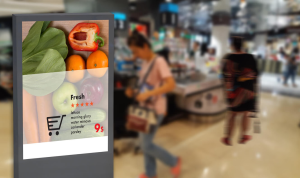 Your technology partners can help you determine the best solutions to build a standout shopping experience and offer insights into everything from optimal screen placement and formats through to the content that resonates most. This is why it’s so important to ask tough questions during your RFI/RFP process when meeting with solution providers. Make sure that you’ll be able to continue working with the partners you want to now, as well as in the future, as your needs and business objectives change. Together, explore how you can deliver content that shoppers find useful and engaging to grow revenue while better managing trade budgets.
Work with them to determine how you can use data more strategically to measure and optimize performance. Understanding how shoppers interact with your content – whether it drives app visits, increases basket sizes, or encourages repeat trips – is central to monetisation. Loyalty programs, promotions, and targeted messaging all benefit from a flexible network architecture that can integrate these data streams effectively.
As for monetisation, strategically build your network backend so that you can deliver a media product that buyers want: a high-quality, well-placed network that can support direct and programmatic ad buys, advanced targeting, and reporting metrics. A hybrid architecture allows retailers to scale capabilities over time, adjust to advertiser needs, and maintain flexibility for future innovations.
In-store media is rapidly evolving, with new shopper engagement and monetisation opportunities emerging all the time. Whether starting your network from scratch or rethinking your current approach, balancing off-the-shelf solutions and custom development is the key to winning with in-store. A hybrid architecture approach supports customised shopper experiences and strong monetisation strategies, setting you up for success that scales.
Check out these tips and get in touch with a Broadsign Representative online or in-person at Retail Technology Show this April in London, where Mike Skene, EMEA Director of Retail Sales, will be on the ground.
Click here to sign up to Retail Gazette‘s free daily email newsletter