

Argos has come under fire after listing a wooden “influencer kit” for toddlers on its website, prompting criticism from parents and child development campaigners who say the toy risks normalising the pressures of online visibility from an early age.
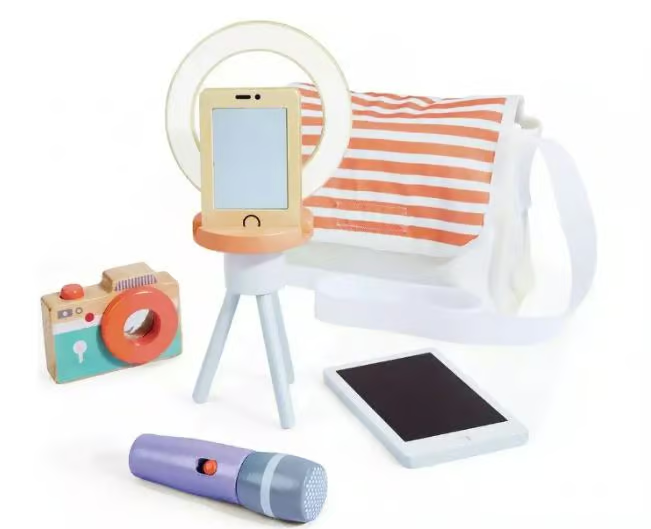
The £15 play set, designed for children aged two and over, includes a tripod, miniature camera with an adjustable aperture lens, smartphone model, tablet and microphone, with all items stored in a carry pouch.
Argos describes the product as a way to “cultivate children’s storytelling skills and creativity through career role-play”, positioning it alongside more traditional role-play toys aimed at encouraging imaginative play.
However, the product has triggered debate over whether influencer culture should be presented to young children in the same way as doctor kits, toy kitchens or tool sets.
Daisy Greenwell, co-founder and director of Smartphone Free Childhood, said the toy reflected a wider cultural shift that many parents would find troubling.
“The best play is about real life – mud kitchens, toy ovens, doctor kits – children copying the world around them and making sense of it,” she said.
“There’s something a bit off about dressing up a very adult, very performative world as a wholesome wooden toy. Influencing is all about chasing attention, so we have to ask what we’re teaching children to value, if that’s the world we’re inviting them to copy.”
The criticism comes amid broader concern over brands marketing adult-coded products and aspirations to young children. Beauty brand Rini, for example, previously faced backlash for promoting cosmetic face masks to children, with dermatologists describing the move as dystopian and warning that the beauty sector was increasingly targeting ever-younger audiences.
Dr Francis Rees, an expert in childhood and digital culture at the University of Essex, said the Argos listing should be understood as part of a broader change in how childhood is being framed.
“While it may be tempting to dismiss this as simply another example of questionable children’s toys, I think it’s more useful to see it as part of a broader shift in how childhood is being imagined,” she said.
“Toys have long reflected adult roles, with doctor sets, kitchens, and toolkits being normal parts of growing up. With ‘influencer’ now ranking highest in surveys of children’s future career aspirations, this product is not entirely surprising.”
However, Rees argued that influencer culture differs significantly from more traditional careers because it is rooted in constant visibility, performance and the monetisation of everyday life.
“It is built around visibility, performance, and the monetisation of everyday life,” she said. “What toys like this normalise is the idea that children are not only participants in play, but also potential objects of attention, as individuals who are watched, followed, and engaged with as ‘content’.”
She added that such normalisation could have wider implications around privacy, digital permanence and identity formation, echoing concerns raised in Unicef’s Industry Toolkit on Children’s Rights and Digital Marketing.
“So, while this toy may well function as imaginative play, it also reflects a wider cultural moment in which forms of highly visible, and often precarious, digital labour are becoming normalised from an early age,” Rees said.
“The question is not simply whether children should play at being influencers, but what kinds of risks we are comfortable with taking in the process, and what career expectations we are preparing them for.”
Argos defended the product, saying it sits within a much broader toy range designed to support imaginative play.
A spokesperson said: “We offer a broad selection of toy sets that encourage imaginative and creative play. This product is part of that wider range, which includes items such as our Chad Valley Tool Box, Wooden Toaster and Pizza Counter sets, designed to help children have fun.”
Click here to sign up to Retail Gazette‘s free daily email newsletter