


‘It was about diversifying the brand’: Why The Black Farmer is looking beyond the farm shop

Last February, The Black Farmer opened its White City location. Seated in the heart of the media district, the new 5,000 sq ft site features a coffee and seating area, deli and butchery selling specialist meats and sausages, seasonal fruit and vegetables, ready meals and Caribbean specialities, including sauces, spices and classics.
Big InterviewGroceryNews

The Black Farmer in nominated for New Store of the Year at this year’s RG Excellence Awards, with its commercial director Alexander Emmanuel-Jones nominated for the Rising Talent Award, he reveals how the next stage is about building on what his father created.

Last February, The Black Farmer opened its White City location. Seated in the heart of the media district, the new 5,000 sq ft site features a coffee and seating area, deli and butchery selling specialist meats and sausages, seasonal fruit and vegetables, ready meals and Caribbean specialities, including sauces, spices and classics.

It marks the second bricks-and-mortar venture the urban farm shop brand has opened in the last three years, following the launch of its Brixton flagship in the heart of south-west London’s Brixton Village community in 2023.

Founded by Wilfred Emmanuel-Jones MBE, many are now familiar with the story of the farmer and businessman who created The Black Farmer brand in 2005, after buying his farm in Devon around the turn of the millennium.

Born in Jamaica and raised in inner-city Birmingham as part of the Windrush generation, Emmanuel-Jones moved from working on his family allotment to producing food programmes for the BBC, helping launch the careers of chefs such as Gordon Ramsay and James Martin.

Nicknamed “the Black Farmer” by locals in Devon, the name stuck and in September 2024 the brand launched first product, a range of premium gluten-free pork sausages. It went on to win awards and secured its first major supermarket listing with Asda later that year.

Now, more than two decades on, The Black Farmer is no longer simply a food brand sold from supermarket shelves. For Alexander Emmanuel-Jones, the company’s commercial director and Wilfred’s son, the next stage is about building on what his father created.

Emmanuel-Jones joined the family business two years ago, after almost a decade in senior supply chain roles at Deliveroo and Sainsbury’s. He says he now looks after the supermarket business, with his father focused on the farm shops and marketing.

“He built up the brand and established a really core foundation,” Emmanuel-Jones says. “Now it’s for me to go, actually, how do we build on these relationships? How do we turn them into strategic partnerships? How do we focus on new areas and new markets?”

‘Supermarkets won’t exist in their current form’

The decision to open physical stores may seem unusual at a time when online grocery shopping is well established and e-commerce boom is stronger than ever. The Black Farmer has not ignored that shift: in 2020, it launched its own direct-to-consumer online shop, allowing customers to order for home delivery or click and collect. Emmanuel-Jones, however, sees the shops as an extension of the brand rather than a retreat from digital retail.

“Opening a bricks-and-mortar farm shop seems mad in this environment,” he says. “But actually for us it was, how can we diversify the brand and the portfolio into something completely new to us?”

The first store, in Brixton, was important to the identity of the business Emmanuel-Jones explains. The location made sense for a brand with Caribbean heritage and gave The Black Farmer a flagship in a community where it could build relationships with customers. But the economics and customer patterns are different.

Photo: The Black Farmer. Founder Wilfred Emmanuel-Jones MBE outside the White City location.

“Brixton normally commutes to Brixton,” Emmanuel-Jones says. The area is quieter during the week, while at weekends people come to explore the market and village. White City works in almost the opposite way.

The former BBC Television Centre is a commuter hub, surrounded by offices, residential developments and Westfield. The Black Farmer took over the site previously occupied by the restaurant Bluebird, and Emmanuel-Jones says the company wanted a location where it could become an anchor rather than be lost among established premium retailers.

“We never wanted to open a store where the road or the street was more famous than us,” he says. At White City, the business can serve a different demographic during the working week; customers might stop for coffee, pick up groceries or meet someone, while the Brixton store relies more heavily on weekend footfall.

The company has also adjusted its pricing and product mix to suit the areas, although Emmanuel-Jones says the overall experience remains much the same. For him, the shops have shown that customers are willing to spend time with a brand in a way that is difficult to replicate from a supermarket shelf.

“In supermarkets it’s purely transactional,” he says. “You’re not really building relationships with people from the shelf edge.”

In the farm shops, customers return for coffee, speak to staff, work from the space or meet friends.

“People are still open to building relationships that you get within farm shops and that you don’t get within the supermarket space.”

“I don’t think supermarkets in their current form will probably exist for the next 10 to 15 years, just because of the way the customer views the proposition,” Emmanuel-Jones says.

Photo: The Black Farmer. Inside The White City location.

Emmanuel-Jones says for The Black Farmer, the goal is not to is not simply to recreate a supermarket in smaller surroundings, but to bring together a butcher, deli, coffee, prepared food and other categories under one roof.

“We don’t call it the Black Farmer Farm Shop,” Emmanuel-Jones says. “he thinking is that the words “farm shop” can make customers decide what they expect before they walk through the door.”

Instead, customers encounter what Emmanuel-Jones describes as “an oasis” of different products and experiences.

The Brixton site has a mezzanine space used for cooking classes, yoga, Pilates and events. Brands can use the space for sampling, with successful new products potentially making their way into the shops. The business also uses its kitchen for hot food delivered through Deliveroo, Just Eat and Uber Eats.

“For us, it’s actually like, well, we’ve created something,” Emmanuel-Jones says. “It’s looking at all the different avenues to really sweat the asset.”

Yet, The Black Farmer remains a relatively small business, and Emmanuel-Jones says opening a store takes roughly a year from scouting a location and signing contracts through design, build and opening. He adds it can take “a good year or so” before a new site begins to make a return.

The company has already secured significant backing as it expands. In January 2025, The Black Farmer secured a £1 million investment from Bibby Financial Services to support its move into high-street retail. That followed a £250,000 investment from the Growth Impact Fund in November 2024.

For a growing business, Emmanuel-Jones says another store would therefore need to be an attractive proposition.

“We’re always on the lookout for new sites and locations and stuff like that,” he says. “But it would have to be a very attractive proposition for us to go, actually, OK, well, let’s give it another go in this area.”

‘How can we spread the message much further?’

The next stage of The Black Farmer’s growth may take the business beyond its two London shops. Emmanuel-Jones says the company is looking at “new markets”, including food service, wholesale and exports.

The business currently operates in the UK, but is considering Europe and the Middle East as potential export markets.

“We’re known for the farm shops, we’re known for our sausages, chicken and our farm shop range,” he says. “Now the [question is], can we really spread the message that we’re trying to tell, the story we’re trying to tell, much further than what we’re doing in the UK?”
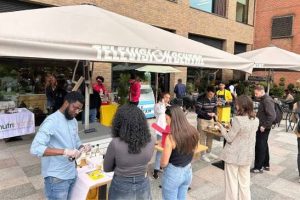
Photo: The Black Farmer. The store hosts a variety of events from yoga to cooking classes.

The ambition is broad; asked whether the company would focus on particular products for those new channels, Emmanuel-Jones says: “Just the whole range, ideally. That’s what we want to focus on.”

The common thread, Emmanuel-Jones says, is the brand itself. “We’ve got a great story to tell, and the brand is way more important than what the product we’re creating,” he says. “It’s never really about the product we’re creating.”

The importance of Wilfred’s story to the brand is even reflected in its customer service chatbot, which greets users as “Wilfred Emmanuel-Jones”, a small but telling way of keeping its founder and heritage present as the business grows.

Emmanuel-Jones says the task now is to make that brand “as strong as possible” and take its story further than the shelves where it first found success.

Emmanuel-Jones joins nominees from Currys, Morrisons and Wayfair in the Rising Talent category at this year’s RG Excellence Awards. See the full shortlist, and all categories here. This year’s RG Excellence Awards will be hosted at the Underglobe on 14 October 2026. 

Click here to sign up to Retail Gazette‘s free daily email newsletter

Big InterviewGroceryNews

Leave a Reply

Your email address will not be published. Required fields are marked *

Fill out this field
Fill out this field
Please enter a valid email address.

‘It was about diversifying the brand’: Why The Black Farmer is looking beyond the farm shop

Last February, The Black Farmer opened its White City location. Seated in the heart of the media district, the new 5,000 sq ft site features a coffee and seating area, deli and butchery selling specialist meats and sausages, seasonal fruit and vegetables, ready meals and Caribbean specialities, including sauces, spices and classics.

The Black Farmer in nominated for New Store of the Year at this year’s RG Excellence Awards, with its commercial director Alexander Emmanuel-Jones nominated for the Rising Talent Award, he reveals how the next stage is about building on what his father created.

Last February, The Black Farmer opened its White City location. Seated in the heart of the media district, the new 5,000 sq ft site features a coffee and seating area, deli and butchery selling specialist meats and sausages, seasonal fruit and vegetables, ready meals and Caribbean specialities, including sauces, spices and classics.

It marks the second bricks-and-mortar venture the urban farm shop brand has opened in the last three years, following the launch of its Brixton flagship in the heart of south-west London’s Brixton Village community in 2023.

Founded by Wilfred Emmanuel-Jones MBE, many are now familiar with the story of the farmer and businessman who created The Black Farmer brand in 2005, after buying his farm in Devon around the turn of the millennium.

Born in Jamaica and raised in inner-city Birmingham as part of the Windrush generation, Emmanuel-Jones moved from working on his family allotment to producing food programmes for the BBC, helping launch the careers of chefs such as Gordon Ramsay and James Martin.

Nicknamed “the Black Farmer” by locals in Devon, the name stuck and in September 2024 the brand launched first product, a range of premium gluten-free pork sausages. It went on to win awards and secured its first major supermarket listing with Asda later that year.

Now, more than two decades on, The Black Farmer is no longer simply a food brand sold from supermarket shelves. For Alexander Emmanuel-Jones, the company’s commercial director and Wilfred’s son, the next stage is about building on what his father created.

Emmanuel-Jones joined the family business two years ago, after almost a decade in senior supply chain roles at Deliveroo and Sainsbury’s. He says he now looks after the supermarket business, with his father focused on the farm shops and marketing.

“He built up the brand and established a really core foundation,” Emmanuel-Jones says. “Now it’s for me to go, actually, how do we build on these relationships? How do we turn them into strategic partnerships? How do we focus on new areas and new markets?”

‘Supermarkets won’t exist in their current form’

The decision to open physical stores may seem unusual at a time when online grocery shopping is well established and e-commerce boom is stronger than ever. The Black Farmer has not ignored that shift: in 2020, it launched its own direct-to-consumer online shop, allowing customers to order for home delivery or click and collect. Emmanuel-Jones, however, sees the shops as an extension of the brand rather than a retreat from digital retail.

“Opening a bricks-and-mortar farm shop seems mad in this environment,” he says. “But actually for us it was, how can we diversify the brand and the portfolio into something completely new to us?”

The first store, in Brixton, was important to the identity of the business Emmanuel-Jones explains. The location made sense for a brand with Caribbean heritage and gave The Black Farmer a flagship in a community where it could build relationships with customers. But the economics and customer patterns are different.

Photo: The Black Farmer. Founder Wilfred Emmanuel-Jones MBE outside the White City location.

“Brixton normally commutes to Brixton,” Emmanuel-Jones says. The area is quieter during the week, while at weekends people come to explore the market and village. White City works in almost the opposite way.

The former BBC Television Centre is a commuter hub, surrounded by offices, residential developments and Westfield. The Black Farmer took over the site previously occupied by the restaurant Bluebird, and Emmanuel-Jones says the company wanted a location where it could become an anchor rather than be lost among established premium retailers.

“We never wanted to open a store where the road or the street was more famous than us,” he says. At White City, the business can serve a different demographic during the working week; customers might stop for coffee, pick up groceries or meet someone, while the Brixton store relies more heavily on weekend footfall.

The company has also adjusted its pricing and product mix to suit the areas, although Emmanuel-Jones says the overall experience remains much the same. For him, the shops have shown that customers are willing to spend time with a brand in a way that is difficult to replicate from a supermarket shelf.

“In supermarkets it’s purely transactional,” he says. “You’re not really building relationships with people from the shelf edge.”

In the farm shops, customers return for coffee, speak to staff, work from the space or meet friends.

“People are still open to building relationships that you get within farm shops and that you don’t get within the supermarket space.”

“I don’t think supermarkets in their current form will probably exist for the next 10 to 15 years, just because of the way the customer views the proposition,” Emmanuel-Jones says.

Photo: The Black Farmer. Inside The White City location.

Emmanuel-Jones says for The Black Farmer, the goal is not to is not simply to recreate a supermarket in smaller surroundings, but to bring together a butcher, deli, coffee, prepared food and other categories under one roof.

“We don’t call it the Black Farmer Farm Shop,” Emmanuel-Jones says. “he thinking is that the words “farm shop” can make customers decide what they expect before they walk through the door.”

Instead, customers encounter what Emmanuel-Jones describes as “an oasis” of different products and experiences.

The Brixton site has a mezzanine space used for cooking classes, yoga, Pilates and events. Brands can use the space for sampling, with successful new products potentially making their way into the shops. The business also uses its kitchen for hot food delivered through Deliveroo, Just Eat and Uber Eats.

“For us, it’s actually like, well, we’ve created something,” Emmanuel-Jones says. “It’s looking at all the different avenues to really sweat the asset.”

Yet, The Black Farmer remains a relatively small business, and Emmanuel-Jones says opening a store takes roughly a year from scouting a location and signing contracts through design, build and opening. He adds it can take “a good year or so” before a new site begins to make a return.

The company has already secured significant backing as it expands. In January 2025, The Black Farmer secured a £1 million investment from Bibby Financial Services to support its move into high-street retail. That followed a £250,000 investment from the Growth Impact Fund in November 2024.

For a growing business, Emmanuel-Jones says another store would therefore need to be an attractive proposition.

“We’re always on the lookout for new sites and locations and stuff like that,” he says. “But it would have to be a very attractive proposition for us to go, actually, OK, well, let’s give it another go in this area.”

‘How can we spread the message much further?’

The next stage of The Black Farmer’s growth may take the business beyond its two London shops. Emmanuel-Jones says the company is looking at “new markets”, including food service, wholesale and exports.

The business currently operates in the UK, but is considering Europe and the Middle East as potential export markets.

“We’re known for the farm shops, we’re known for our sausages, chicken and our farm shop range,” he says. “Now the [question is], can we really spread the message that we’re trying to tell, the story we’re trying to tell, much further than what we’re doing in the UK?”

Photo: The Black Farmer. The store hosts a variety of events from yoga to cooking classes.

The ambition is broad; asked whether the company would focus on particular products for those new channels, Emmanuel-Jones says: “Just the whole range, ideally. That’s what we want to focus on.”

The common thread, Emmanuel-Jones says, is the brand itself. “We’ve got a great story to tell, and the brand is way more important than what the product we’re creating,” he says. “It’s never really about the product we’re creating.”

The importance of Wilfred’s story to the brand is even reflected in its customer service chatbot, which greets users as “Wilfred Emmanuel-Jones”, a small but telling way of keeping its founder and heritage present as the business grows.

Emmanuel-Jones says the task now is to make that brand “as strong as possible” and take its story further than the shelves where it first found success.

Emmanuel-Jones joins nominees from Currys, Morrisons and Wayfair in the Rising Talent category at this year’s RG Excellence Awards. See the full shortlist, and all categories here. This year’s RG Excellence Awards will be hosted at the Underglobe on 14 October 2026. 

Click here to sign up to Retail Gazette‘s free daily email newsletter

Social


SUBSCRIBE TO OUR DAILY NEWSLETTER

  • This field is for validation purposes and should be left unchanged.
Big InterviewGroceryNews

Leave a Reply

Your email address will not be published. Required fields are marked *

Fill out this field
Fill out this field
Please enter a valid email address.

RELATED STORIES

Latest Feature


Menu


Please enter the verification code sent to your email:
