

UK retailers are increasingly seeing AI agents carry out transactions on their platforms, but many remain unclear over who is liable when purchases go wrong, according to new research from The Payments Association.
The trade body’s new report, Agentic commerce in UK retail, an unresolved liability question, found that 58 per cent of UK online retail merchants believe AI-initiated transactions have already reached their platforms.
The research, conducted among 100 senior finance, payments and risk leaders at UK online retail businesses during Q1 2026, suggests agentic commerce is moving rapidly from theory to reality.
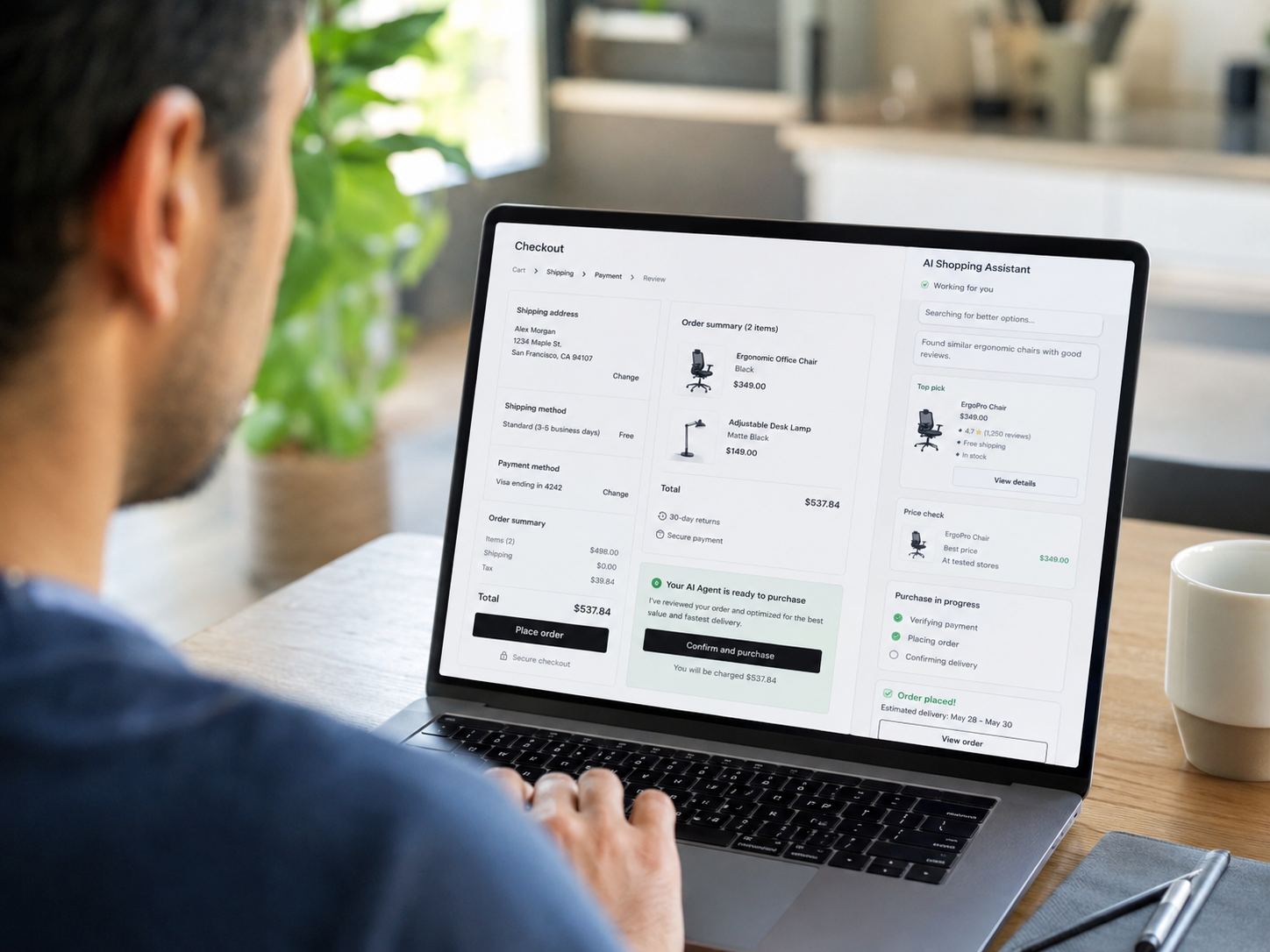
The Payments Association said the rise of autonomous AI agents, which can search for products, select merchants and complete purchases on behalf of consumers, is outpacing the liability, authentication and operational frameworks needed to support it.
No respondents described agentic commerce as irrelevant to their business, while 72 per cent said they were either preparing or planning their approach to autonomous AI purchasing.
However, the report found significant uncertainty over responsibility when disputes arise. When respondents were presented with a hypothetical disputed £2,000 purchase made by an AI agent, 24 per cent said liability would depend on the specific circumstances, 21 per cent backed a shared liability model, and 18 per cent said the AI vendor should be responsible.
Only 41 per cent of respondents said they felt very confident in current liability frameworks.
The Payments Association chief executive Emma Banymandhub said agentic commerce was “arriving faster than many merchants expected”.
“The concern is that businesses are already processing AI-initiated transactions without the controls, liability clarity or transaction visibility needed to manage the risks properly,” she said.
“Fraud engines built around human behavioural signals are misfiring on legitimate agent traffic, and the question of who carries the loss when an agent transacts incorrectly remains unresolved.”
The report comes as major payment networks, including Visa and Mastercard, have introduced frameworks for agentic commerce, while Google, OpenAI and the FIDO Alliance have also published open protocols for agent-initiated checkout.
However, The Payments Association warned that many identifiers and protocols are not yet widely available in the UK, leaving merchants unable to clearly identify when transactions are being initiated by AI agents.
Banymandhub said the industry was beginning to coalesce around ‘Know Your Agent’ as a complement to existing Know Your Business and Know Your Customer obligations.
She added that UK regulators, including the Financial Conduct Authority, had signalled they were reviewing how existing rules apply to agent-initiated payments.
“Over the next 12 months, the industry will need to converge on common standards for authentication, accountability and consumer protection if trust in these systems is to scale safely,” she said.
The Payments Association’s Merchant Payments Working Group is urging retailers to audit fraud systems, review internal controls and assess payment provider readiness ahead of expected UK regulatory scrutiny in 2026.
The report found merchants with formal policies already in place were nearly four times more likely to feel confident in liability frameworks than those without, suggesting early governance could be a key factor in readiness for AI-led commerce.
Click here to sign up to Retail Gazette‘s free daily email newsletter