

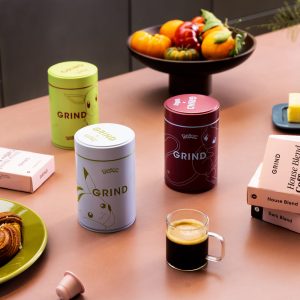
Cult London-based coffee company Grind has a knack for sticking in the mind. There are the instantly recogniseable pink tins on kitchen shelves. The coffee cups photographed on British Airways flights. The cafés that are themselves iconic spaces to Londonders, as much as places to grab a quick caffeine boost.
And of course, the Old Street cinema sign, which has become a miniature media channel in its own right, delivering one-liners to passing commuters and revellers with more charm than most paid campaigns can manage.
It’s easy to look at Grind and see a brand that’s simply hellbent on having fun. After all, how many other coffee companies are striking collab deals with the likes of Pokemon and Clueless? In reality, that sense of ease is the product of some serious discipline.
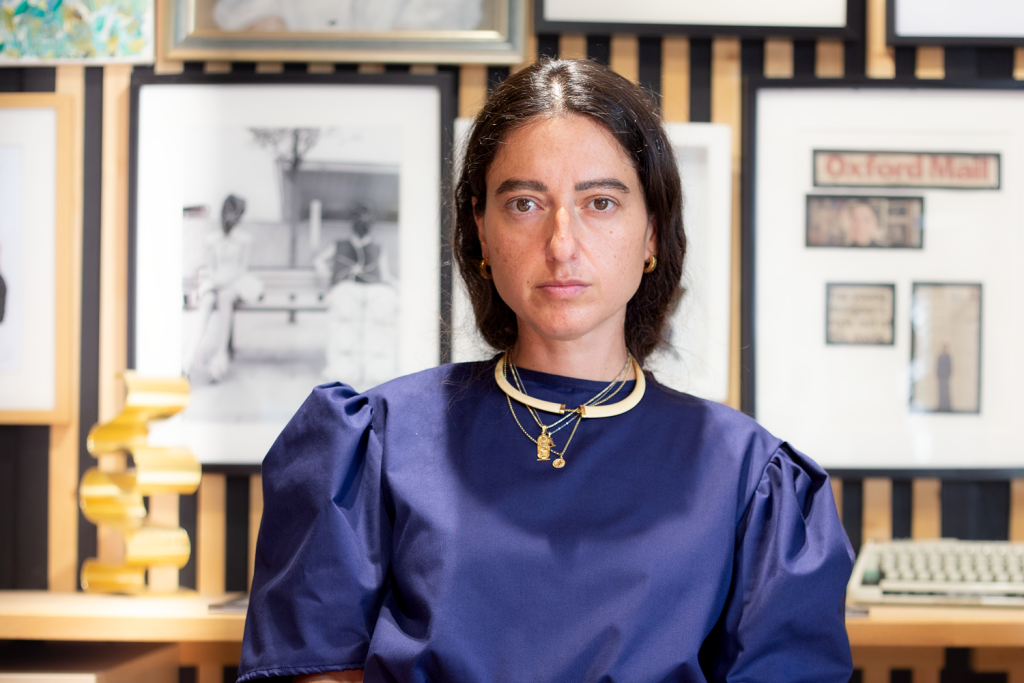
For Stacey Britt Fitzgerald, brand director at Grind, the heart of her job is protecting the coherence of a business that now spans hospitality, grocery, ecommerce, partnerships, physical retail, social content, sustainability and national awareness.
“Brand is the job of making people feel something consistently,” she says. “It’s not just the logo, the tone of voice or the campaign. It’s every decision a customer experiences, whether that’s the way a café feels at 8am, the wording on the back of a coffee tin, or how you respond when something goes wrong.”
Grind has undoubtedly become one of the UK’s most distinctive coffee brands, not because it sees the concept of brand as a marketing layer, but in-fact because brand is at the heart of its strategy – along with delivering a quality product to its audience.
A career built on culture, not a masterplan
Fitzgerald’s route to Grind wasn’t linear. Her CV includes Condé Nast, Urban Outfitters, BuzzFeed and other brands that truly understand the power of culture, content and community. It looks, from the outside, like a carefully curated path through some of the sharpest names in media and lifestyle. She laughs at the idea.
“Honestly, it has been surprisingly random,” she says. “I wish I could tell you there was some grand masterplan, but there really wasn’t.”
The first half of her career was spent in media, moving from print into digital before eventually crossing over to the brand side. That transition, she says, is harder than people often imagine, particularly when a decade of experience has already placed you firmly in a professional lane.
Urban Outfitters changed that. It was Fitzgerald’s first proper brand role, and it helped her realise that the skills she had built in media, storytelling, cultural awareness, understanding audiences, spotting what resonates, could be applied directly to brand building.
That mix now feels tailor-made for Grind. “I’ve always been drawn to brands with a really strong point of view,” she says. “Brands that sit at the intersection of culture and commerce, and brands that make people feel something.”
That’s a pretty neat description of Grind itself, really.
Founded in 2011 by David Abrahamovitch, who turned his father’s old mobile phone shop in Shoreditch into what became Shoreditch Grind, the business has grown from East London café-bar into a coffee company with 14 London locations, a thriving online business, grocery distribution, airline partnerships and its own London roastery.
That breadth creates bundles of opportunity, however it also creates risk.

The discipline behind distinctiveness
Grind does a lot. “Grind now exists in cafés, supermarkets, airports, train stations, offices, on British Airways flights, on social media, and in people’s kitchens,” Fitzgerald says. “The risk is that every one of those touchpoints starts to feel slightly different until eventually you no longer feel like one brand.”
For many businesses, that level of channel expansion is where brand coherence starts to fray. Each touchpoint develops its own logic, and each commercial opportunity pulls the business in a slightly different direction. Before long, the brand becomes a set of loosely connected outputs rather than a recognisable world.
The answer, she argues, is not to make everything identical. That would flatten the brand and ignore the different role each channel plays. Instead, the goal is to make every touchpoint feel unmistakably Grind.
That means clear non-negotiables. Grind should be optimistic, witty, design-led, a little irreverent, but still premium. It should be accessible without becoming bland. It should make craft coffee feel desirable, but never intimidating.
“We want to be premium, but never pretentious,” Fitzgerald notes. “We want to feel like a lifestyle brand, not just a coffee company.”
That’s a hard balance to strike. Premium brands often become cold, whilst playful brands can lose credibility. Lifestyle brands can drift into vagueness. Grind’s challenge is to keep all of those elements in tension while continuing to grow.
For Fitzgerald, the central questions are always the same. What are the things only Grind could say? What are the things only Grind could do? What will people remember?
“The themes I come back to constantly are consistency, memory, and emotion,” she says. “Are we building distinctive assets over time? Does this feel true to who we are?” In other words, brand isn’t the pursuit of constant novelty, but the repeated investment in recognisable meaning.

The assets hiding in plain sight
One of the most valuable lessons from Grind’s brand playbook is that distinctive assets often reveal themselves through customer behaviour.
For Fitzgerald, assets are much bigger than a logo or colour palette. At Grind, they include the pink, the tone of voice, the cafés, the packaging, the founder story, the London roastery, and the brand’s particular take on coffee-meets-culture.
But they also include the things people naturally photograph, share and repeat.
“What are customers photographing? What do they mention in reviews? What do journalists write about without being prompted? What are people sharing on TikTok?” she asks.
A simple search on social media yields our answers. People photograph the cups. They photograph the cafés. They photograph the Old Street sign. They photograph the pink tins. They photograph Grind coffee on British Airways flights, often held up against the aircraft window.
Each of those moments is doing brand-building work not in the abstract, but in the most practical sense. They’re creating memory, recognition and emotional association.
This is where Grind’s power as a distinctive brand becomes commercially powerful. A tin in someone’s kitchen isn’t just packaging, it’s a media placement, and also a status symbol. A café isn’t just a store but a physical brand experience. These are signals that the brand has entered a new cultural context.
That’s the kind of thinking that separates strong brands from ‘busy’ ones.
“The job is being disciplined enough to keep investing in those things instead of constantly chasing whatever is new,” Fitzgerald says. “A lot of brands get distracted by trends and forget to build memory over time.”
Partnerships with fun, but also purpose
That same thinking shapes Grind’s approach to partnerships. Brand collaborations have become a standard feature of modern marketing, but many still amount to little more than ‘two logos placed side by side’. Fitzgerald isn’t interested in that.
“The best partnerships are not just two logos next to each other,” she says. “They should feel slightly unexpected, but immediately obvious once you see them.” For Grind, the strongest partnerships have been rooted in culture. Pokémon worked because it tapped into millennial nostalgia, but through an elevated Grind lens. British Airways works because it brings together two British brands with a focus on quality, ritual and experience.
A good partnership gives consumers a new entry point into the brand. Someone might first encounter Grind because they love Pokémon, or because they had the coffee on a flight. Then they discover the cafés, the grocery range, the online shop, the tins, the broader brand world.
But Fitzgerald is increasingly focused on partnerships that do more than generate reach.
“Community beats influencers every time. I would always rather create something that makes a smaller group of people genuinely obsessed than something millions of people scroll past and forget.”
Attention’s easy to buy and hard to convert into meaning. However obsession is harder to create, but far more valuable. The partnerships that fail, Fitzgerald says, are usually too transactional, too obvious, or based entirely on the other brand being big.
 Choosing channels with intent
Every marketer knows the unyielding pressure to be everywhere, especially in a world where new channels can pop-up overnight. TikTok, Instagram, PR, CRM, retail media, out-of-home, podcasts, events, influencers, partnerships, packaging, stores, the list goes on and on. And each comes with someone arguing that it’s essential.
Fitzgerald is wary of that logic.
“One of the most dangerous things in marketing is trying to do everything equally,” she says. “You end up spreading yourself too thin and being forgettable everywhere.”
Instead, Grind starts with the role each channel can realistically play. Social is useful for personality and participation. PR builds credibility. Cafés are powerful because people physically experience the brand. Packaging is perhaps the biggest media channel because it sits in people’s homes every day.
“A TikTok shouldn’t feel like a press release,” Fitzgerald says of her channel strategy. “A billboard should not feel like an Instagram caption.”
The business edge of creativity
Of course, the bigger a business becomes, the more complex brand leadership gets.
When Fitzgerald joined Grind, the brand team was smaller and her role was more hands-on. She was writing copy, taking meetings and directly shaping outputs. As the company has grown, her work has become broader and more operational. Campaign planning, strategy, partnerships, grocery, national awareness and scaling the brand now take up more of her time.
“The hardest thing is that when a brand gets bigger, complexity increases exponentially,” she says. “More stakeholders, more channels, more opinions, more things happening at once.”
That’s the less glamorous side of brand building, but arguably the most important. Good creative work doesn’t survive at scale without systems. Guidelines, approval processes, shared internal understanding and senior advocacy all become essential.
“You are no longer just making the work,” Fitzgerald says. “You are building the systems and alignment that allow good work to happen consistently.”
That is particularly important when the ideas are bold, and sometimes a little bonkers on paper. At Grind, Fitzgerald says she’s fortunate to work with supportive leadership, including founder and CEO David Abrahamovitch, who has a strong brand and marketing instinct himself.
But even in a receptive business, creative ideas need to be sold internally. That means showing potential impact, acknowledging that the science is not always perfect, and learning from what did not work previously.
“We keep that advocacy sustained by ensuring the next pitch addresses what didn’t work last time and how we plan to account for that in our next go,” she says.
It’s a useful reminder that creative cultures aren’t built on blind faith, but on trust, evidence, momentum and the ability to learn without becoming timid.
Compliance doesn’t have to kill creativity
For food, drink and lifestyle brands, that operating environment is becoming more demanding. Sustainability claims, health messaging, provenance and ethical sourcing are all under greater scrutiny. Consumers are undoubtedly more informed, and regulators are paying closer attention. Vague feel-good language no longer carries the same licence it once did.
Grind, which is now B Corp certified and has built a significant part of its proposition around more sustainable coffee, compostable pods, recyclable packaging, ethical trading and its Better Coffee Foundation, has to tread carefully.
Fitzgerald sees that scrutiny as a challenge, but not an enemy of creativity. “There is much more scrutiny now around what brands can say, particularly around sustainability, health, and provenance,” she says. “The challenge is making sure you do not lose the emotional part of storytelling while still being accurate.”
That means moving away from broad claims and towards specificity. Brands can’t simply say “sustainable” or “ethical” and expect consumers to fill in the blanks. They need to explain what they mean, what they’re doing, and what can be substantiated.
“I don’t think compliance and creativity are opposites,” Fitzgerald says. “If anything, the constraints force you to be more specific, more interesting and more honest.”
The point could apply far beyond sustainability. The strongest brands rarely have loose guardrails. More often, they know exactly who they are, what they can credibly say, and where they shouldn’t go.

Why the iconic Old Street sign is a marketer’s hidden gem
For all the strategy, systems and commercial edge behind Grind’s growth, some of the brand’s most memorable work is also its simplest.
The Shoreditch Grind cinema sign on Old Street roundabout has become one of the brand’s most beloved physical assets. Fitzgerald lights up when it comes up.
“We love that sign,” she says. “Our copywriter Alice writes most of them and she’s brilliant. Brainstorming what to write next is one of my favourite parts of the job.”
Its power lies in its authenticity. It’s not trying to dominate a media plan or chasing the algorithm. It exists in the physical world, catching people on the way to work or from the top deck of a bus, offering a small moment of wit, wisdom or simply a bit of sillyness.
“The Shoreditch Grind cinema sign works because it feels like a little gift,” Fitzgerald says. “You are not expecting it, you see it on your way to work or on the bus, and suddenly you smile or take a photo.”
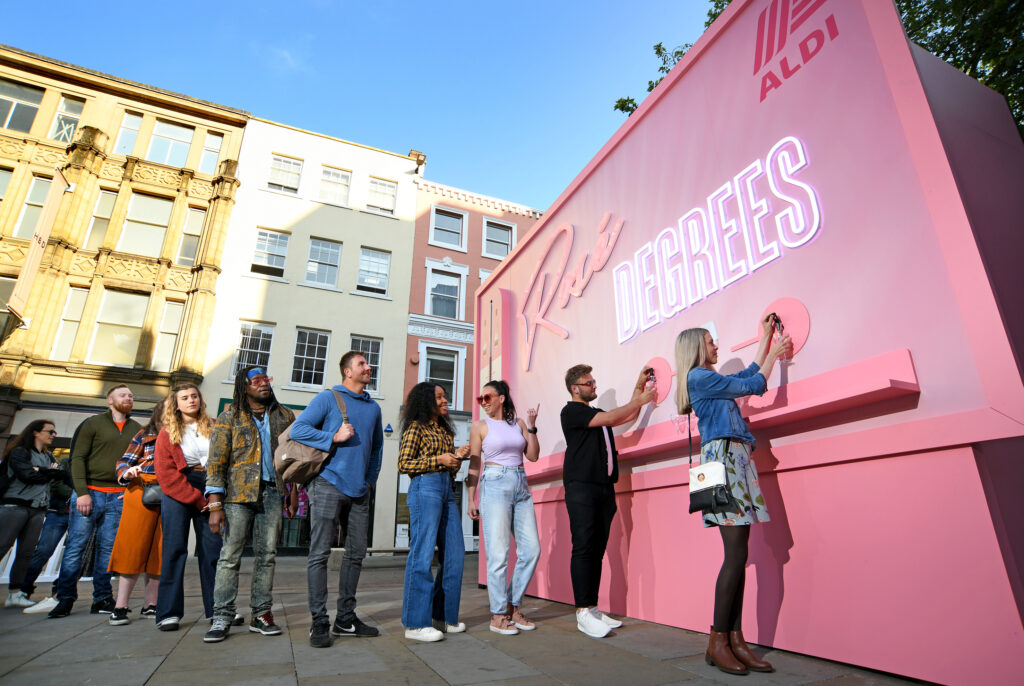
“I’m much more interested in one small but brilliant thing that people genuinely remember than ten generic media placements,” Fitzgerald says. “A sign on Old Street. A cup people photograph on a plane. A pop-up that makes people queue. Those moments might seem small, but they are often the things that make a brand feel human and unforgettable.”
Taking a key learning from Grind
There’s a lot marketers can learn from Grind. It’s a brand flourishing in a dense and established market, and doing so on its own terms. However, perhaps the biggest lesson is that yes, distinctiveness is a vibe, but it’s also a discipline.
It’s the discipline to know what only your brand can say, to keep investing in assets people already remember. The discipline to say no to channels, partnerships and conversations that just don’t fit, and to treat packaging, cafés, signs, flights and social posts as parts of one connected system. It’s very much the discipline to stay playful without becoming careless, and commercial without becoming bland.
Fitzgerald’s career may not have followed a grand masterplan, but at Grind she has found a brand that rewards the mix of skills she has gathered along the way; media instinct, cultural fluency, creative judgement and business pragmatism.
So many brands are chasing attention, but Grind is looking inward, and using the tools it’s developed organically to gain influence. That’s a much harder game, but a far more valuable one.
As Fitzgerald puts it, the sweet spot is when someone sees something new from the brand and thinks: “I didn’t expect that, but of course Grind would do it!”
Click here to sign up to Retail Gazette‘s free daily email newsletter