DHL’s Spencer Conday on how heatwaves are reshaping Christmas run-up

DHL - The holidays may be over four months away, but Christmas calendars are already landing on doorsteps, even as the UK undergoes record heatwaves. It might feel wrong, opening a cardboard advent calendar while the weather forecast app reads something close to 34 degrees, but for the people who actually move Britain's Christmas stock from factory to front door, that timing is not strange at all.
5 minutes with...Supply Chain

The festive period may be months away, but Christmas calendars are already landing on doorsteps, even as the UK undergoes record heatwaves. It might feel wrong, opening a cardboard advent calendar while the weather forecast app reads something close to 34 degrees, but for the people who actually move Britain’s Christmas stock from factory to front door, that timing is not strange at all.

Photo: DHL Supply Chain UK&I managing director for retail and ecommerce Spencer Conday

DHL Supply Chain UK&I managing director for retail and ecommerce Spencer Conday says the UK has just come off the back of one of the hottest summers British shoppers and retailers have ever lived through.

Five separate heatwaves swept the country between May and August this year, and the season has provisionally been declared the warmest on record, beating even the legendary summer of 1976.

Yet, the global logistics giant has managed to keep up, now well versed in quickly adapting to the unexpected, whether facing unpredictable weather or geopolitical supply chain disruptions.

“We’ve become experts in the unknown,” Conday says. “The ability to be able to step up our requirements, lean into the wider organisation, has proven to be a real success over the last few years.”

That was certainly true this year. In one convenience business Conday works closely with, he says what would normally be a six-week seasonal spike stretched to sixteen weeks, driven by five separate heat spells rather than the usual one or two.

Locking down Christmas before the summer holidays

However, whatever the weather does, one date in the calendar does not move. “We tend to set ourselves a target as a business to work with our customers on locking down the first phase of our peak plan by the August bank holiday,” Conday explains.

“In some cases we see customer volumes going from twenty to forty per cent increase during that seasonal peak, so it’s on us to ensure that we’ve got the right type of resource plans, the right type of equipment, and also demonstrate the ability to execute that ramp.”

That optimism about Christmas trading is not blind to the wider economic picture. “Many of our customers still carry a degree of optimism, notwithstanding the geopolitical and macro and micro economic climates and headwinds we face into,” he says.

Retailers nationally seem to share that early urgency. Industry surveys ahead of this year’s peak found that the vast majority of retail logistics leaders expect demand to rise again this Christmas compared with last year, even as many admit they are likely to be forced into reactive decisions once the volume actually arrives.

Deloitte’s 2026 Holiday Forecast found that overall holiday retail sales are projected to grow between 4 per cent and 4.8 per cent, totalling up to £1.26tr ($1.71tr). Order volumes during the busiest weeks can run three to five times higher than a normal trading day.

Inside the warehouse, that early planning shows up as a kind of choreography. “We would be moving slow-moving out-of-season products to the far corners of a distribution centre. And as we’re bringing in new seasonal products that we know are going to be fast-moving, we would position them in a location that supports the ability to drive productivity,” Conday says.
“But it’s not like a moment in time. We don’t just stop for summer and then start for autumn and then move into Christmas. This is an evolutionary process that goes on week by week, season through season, as we move through the year.”

Technology is playing a growing role in that choreography, though Conday is careful not to overstate it. “I would say we’re on the fringes of using AI, so we are starting to deploy it,” he says, pointing to a new digital twin capability that lets DHL trial changes before making them for real.

“It allows us to simulate warehouse operations or transport network simulations as if it were being operated in real time. We don’t necessarily need to make changes to the physical infrastructure. We can simulate it via the digital twin.” Getting the data right matters just as much as the technology itself, he adds: “In order for AI to work effectively, poor data in will result in poor results coming out.”

But for all the interest in new tools, Conday keeps coming back to one question his teams ask themselves before adopting any of them. “AI is a cool thing to talk about,” he says. “It’s got to result in a so what. What does that mean for the DHL organisation and our customers’ business, that’s the super important thing. We often challenge ourselves as a team on that, so what, on a number of occasions.”

Humans, robots and a bit of Christmas magic

For all the talk of automation, Conday is adamant that some jobs will remain stubbornly human for a while yet. Gift wrapping is his favourite example. “The tying of a bow, I think it would be a little more shaky,” he says, only half joking, when asked whether a robot could ever replicate the finishing touches some of DHL’s beauty and luxury clients expect.
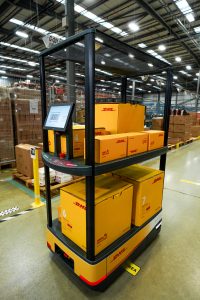
Photo: DHL. 

“That’s not to say that it won’t be done in the future, everything’s possible, but the level of dexterity that a number of our colleagues need to demonstrate will be there for a little while.”

That attention to detail reflects a wider shift in what shoppers expect. Retailers now have to serve customers through what Conday calls omni-channel demand, and he says that reshapes what happens on the warehouse floor. “In simplistic terms, large quantities of the same item will invariably go to store,” he explains.

“Whereas if we’re direct to consumer, it might be a single item, and that requires a different type of equipment, and in some cases a different process flow altogether, because we need to be able to pack and protect that customer’s product that’s going to go through the carrier network.”

Speed itself is becoming more nuanced too, with next day delivery cut-off times have crept later and later over the years, and same day delivery is now standard for many retailers. But Conday suspects the next shift will not simply be about going faster still. “Time sensitivity will play a part in the future,” he says.

“If you buy a high-value product, then you will invariably be given a one-hour window. But in the general consumer space, it will be a same-day commitment, a next-day commitment, but it might not necessarily be time-bound. I want a greater level of clarity as to when that will be delivered, so I can manage my time around it.” Return rates over the festive period, driven by gifting and sizing issues, only add to that pressure once the boxes start coming back in January.

None of it, Conday insists, comes down to chasing the latest gadget for its own sake. His ambition for this Christmas is refreshingly simple. “If we get to January and we can sit back and say that we’ve delivered everything one hundred per cent on time, in full, better than budget,” he says, “then we’ll be a happy team.”

Click here to sign up to Retail Gazette‘s free daily email newsletter

5 minutes with...Supply Chain

Leave a Reply

Your email address will not be published. Required fields are marked *

Fill out this field
Fill out this field
Please enter a valid email address.

DHL’s Spencer Conday on how heatwaves are reshaping Christmas run-up

DHL - The holidays may be over four months away, but Christmas calendars are already landing on doorsteps, even as the UK undergoes record heatwaves. It might feel wrong, opening a cardboard advent calendar while the weather forecast app reads something close to 34 degrees, but for the people who actually move Britain's Christmas stock from factory to front door, that timing is not strange at all.

The festive period may be months away, but Christmas calendars are already landing on doorsteps, even as the UK undergoes record heatwaves. It might feel wrong, opening a cardboard advent calendar while the weather forecast app reads something close to 34 degrees, but for the people who actually move Britain’s Christmas stock from factory to front door, that timing is not strange at all.

Photo: DHL Supply Chain UK&I managing director for retail and ecommerce Spencer Conday

DHL Supply Chain UK&I managing director for retail and ecommerce Spencer Conday says the UK has just come off the back of one of the hottest summers British shoppers and retailers have ever lived through.

Five separate heatwaves swept the country between May and August this year, and the season has provisionally been declared the warmest on record, beating even the legendary summer of 1976.

Yet, the global logistics giant has managed to keep up, now well versed in quickly adapting to the unexpected, whether facing unpredictable weather or geopolitical supply chain disruptions.

“We’ve become experts in the unknown,” Conday says. “The ability to be able to step up our requirements, lean into the wider organisation, has proven to be a real success over the last few years.”

That was certainly true this year. In one convenience business Conday works closely with, he says what would normally be a six-week seasonal spike stretched to sixteen weeks, driven by five separate heat spells rather than the usual one or two.

Locking down Christmas before the summer holidays

However, whatever the weather does, one date in the calendar does not move. “We tend to set ourselves a target as a business to work with our customers on locking down the first phase of our peak plan by the August bank holiday,” Conday explains.

“In some cases we see customer volumes going from twenty to forty per cent increase during that seasonal peak, so it’s on us to ensure that we’ve got the right type of resource plans, the right type of equipment, and also demonstrate the ability to execute that ramp.”

That optimism about Christmas trading is not blind to the wider economic picture. “Many of our customers still carry a degree of optimism, notwithstanding the geopolitical and macro and micro economic climates and headwinds we face into,” he says.

Retailers nationally seem to share that early urgency. Industry surveys ahead of this year’s peak found that the vast majority of retail logistics leaders expect demand to rise again this Christmas compared with last year, even as many admit they are likely to be forced into reactive decisions once the volume actually arrives.

Deloitte’s 2026 Holiday Forecast found that overall holiday retail sales are projected to grow between 4 per cent and 4.8 per cent, totalling up to £1.26tr ($1.71tr). Order volumes during the busiest weeks can run three to five times higher than a normal trading day.

Inside the warehouse, that early planning shows up as a kind of choreography. “We would be moving slow-moving out-of-season products to the far corners of a distribution centre. And as we’re bringing in new seasonal products that we know are going to be fast-moving, we would position them in a location that supports the ability to drive productivity,” Conday says.

“But it’s not like a moment in time. We don’t just stop for summer and then start for autumn and then move into Christmas. This is an evolutionary process that goes on week by week, season through season, as we move through the year.”

Technology is playing a growing role in that choreography, though Conday is careful not to overstate it. “I would say we’re on the fringes of using AI, so we are starting to deploy it,” he says, pointing to a new digital twin capability that lets DHL trial changes before making them for real.

“It allows us to simulate warehouse operations or transport network simulations as if it were being operated in real time. We don’t necessarily need to make changes to the physical infrastructure. We can simulate it via the digital twin.” Getting the data right matters just as much as the technology itself, he adds: “In order for AI to work effectively, poor data in will result in poor results coming out.”

But for all the interest in new tools, Conday keeps coming back to one question his teams ask themselves before adopting any of them. “AI is a cool thing to talk about,” he says. “It’s got to result in a so what. What does that mean for the DHL organisation and our customers’ business, that’s the super important thing. We often challenge ourselves as a team on that, so what, on a number of occasions.”

Humans, robots and a bit of Christmas magic

For all the talk of automation, Conday is adamant that some jobs will remain stubbornly human for a while yet. Gift wrapping is his favourite example. “The tying of a bow, I think it would be a little more shaky,” he says, only half joking, when asked whether a robot could ever replicate the finishing touches some of DHL’s beauty and luxury clients expect.

Photo: DHL. 

“That’s not to say that it won’t be done in the future, everything’s possible, but the level of dexterity that a number of our colleagues need to demonstrate will be there for a little while.”

That attention to detail reflects a wider shift in what shoppers expect. Retailers now have to serve customers through what Conday calls omni-channel demand, and he says that reshapes what happens on the warehouse floor. “In simplistic terms, large quantities of the same item will invariably go to store,” he explains.

“Whereas if we’re direct to consumer, it might be a single item, and that requires a different type of equipment, and in some cases a different process flow altogether, because we need to be able to pack and protect that customer’s product that’s going to go through the carrier network.”

Speed itself is becoming more nuanced too, with next day delivery cut-off times have crept later and later over the years, and same day delivery is now standard for many retailers. But Conday suspects the next shift will not simply be about going faster still. “Time sensitivity will play a part in the future,” he says.

“If you buy a high-value product, then you will invariably be given a one-hour window. But in the general consumer space, it will be a same-day commitment, a next-day commitment, but it might not necessarily be time-bound. I want a greater level of clarity as to when that will be delivered, so I can manage my time around it.” Return rates over the festive period, driven by gifting and sizing issues, only add to that pressure once the boxes start coming back in January.

None of it, Conday insists, comes down to chasing the latest gadget for its own sake. His ambition for this Christmas is refreshingly simple. “If we get to January and we can sit back and say that we’ve delivered everything one hundred per cent on time, in full, better than budget,” he says, “then we’ll be a happy team.”

Click here to sign up to Retail Gazette‘s free daily email newsletter

Social


SUBSCRIBE TO OUR DAILY NEWSLETTER

  • This field is for validation purposes and should be left unchanged.
5 minutes with...Supply Chain

Leave a Reply

Your email address will not be published. Required fields are marked *

Fill out this field
Fill out this field
Please enter a valid email address.

RELATED STORIES

Latest Feature


Menu

Get Inside Matalan

A supply chain case study delivered to your inbox in three emails. The 3 elements Matalan changed to impact its bottom line..

Matalan Supply Chain Programme Form

  • This field is for validation purposes and should be left unchanged.


Please enter the verification code sent to your email: