

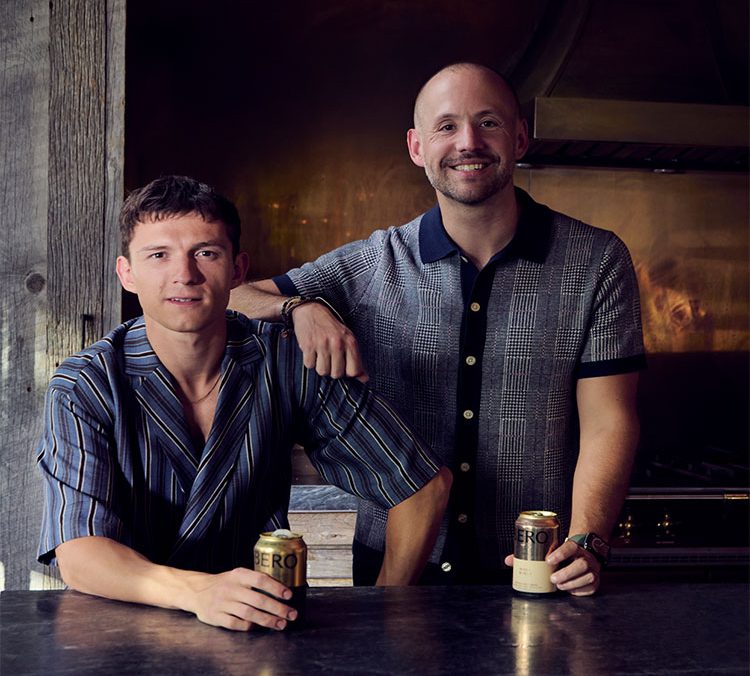
When John Herman left a senior role at one of America’s fastest-growing energy drink companies, he wasn’t looking to build another beverage brand. Yet less than two years later, he finds himself at the helm of one of the most closely watched names in the rapidly expanding non-alcoholic drinks market.
The business in question is BERO, the premium alcohol-free beer company, co-founded with actor Tom Holland. Born in London, brewed in America and now stocked by retailers including Morrisons and Selfridges, the brand is positioning itself as more than simply another entrant in the no- and low-alcohol category. Herman believes it represents a broader shift in consumer behaviour.
“We set out to create something that was premium. It was aspiration, it was lifestyle,” he says. “Ultimately, a brand that people would want to be part of.”
The timing also appears favourable. According to IWSR, no and low alcohol products continue to be among the fastest-growing segments in global drinks, with no-alcohol volumes forecast to increase by 36% by 2029. In the UK alone, no-alcohol beer recorded 20% growth in 2024, while US sales of non-alcoholic beer, wine and spirits surpassed $1bn in off-premise channels last year.
For Herman, however, BERO’s origins lie less in market data than in two personal experiences converging at the right moment.
Before launching the company, Herman spent nine years helping scale a fast-growing energy drink business before its investment by Keurig Dr Pepper. At the same time, Holland was embarking on a period of sobriety that would ultimately inspire the brand’s creation.
“Tom was going on a year and a half sober,” Herman recalls. “He realised he had never felt better than when he made the decision to eliminate alcohol from his life. Better physically, better mentally, better clarity, better professionally and, he would say, better in his relationships.”
Yet Holland felt something was missing.
“He didn’t see a brand out there that really supported this idea of aspiration, coolness, lifestyle and ultimately inclusivity in traditional drinking settings,” Herman says. “Many of them felt more functional in format.”
For Herman, the opportunity looked slightly different. Unlike Holland, he still drinks alcohol occasionally but saw a growing place for premium non-alcoholic options within modern lifestyles.
“I still enjoy wine,” he says. “But after a glass of wine at dinner, there’s a wonderful world for non-alcoholic beverages. Professionally, personally, trying to stay active, having a young daughter, there was a place for non-alcohol in my life.”
Catering for the younger consumer
While the alcohol-free category has traditionally skewed towards older consumers moderating their intake, Herman says BERO is attracting a younger audience.
“Roughly two-thirds of our consumers are under the age of 45,” he says. “In the broader non-alcoholic category, only about 45% of consumers are under 45.”
That demographic profile is no accident. Holland, who recently celebrated his 30th birthday, sits squarely within the brand’s target audience. Herman describes BERO’s customer as slightly more affluent, more educated and often navigating the competing demands of careers, young families and health-conscious lifestyles.
The customer base remains around 60% male and 40% female, although Herman believes that split compares favourably with traditional beer.
The wider backdrop is a generation rethinking its relationship with alcohol. NHS England data shows that a quarter of people aged between 16 and 24 did not drink alcohol in the previous year, while a growing number of younger consumers are embracing moderation rather than abstinence.
At the same time, Herman rejects the idea that younger consumers are abandoning social drinking altogether.
“The important part isn’t necessarily the alcohol that gives you the buzz,” he says. “It’s the environment that you find yourself in.”
That social element, he argues, is helping to drive growth across the category.
Prior to the pandemic, health and wellness trends were already reshaping food and drink. Covid accelerated the shift. Herman points to the emergence of brands such as Olipop and Poppi in the US, alongside changing perceptions of legacy energy drinks.
“The same thing is happening to beer,” he says. “People are looking to make better, healthier decisions.”
Why BERO is betting on shandy
That philosophy underpins BERO’s latest launch: a limited-edition shandy range featuring lemon-lime, pink grapefruit, elderflower and blackberry yuzu variants.
The move marks a notable departure from traditional alcohol-free beer and perhaps provides a clue as to where the category is heading next.
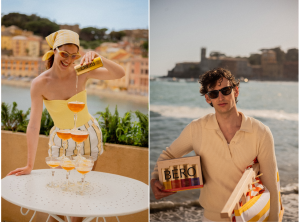
The collection consists of 70% lemonade and 30% beer, built on BERO’s Kingston Golden Pils base and packaged in brightly coloured 12oz cans designed to evoke “a trip to the Italian coast”.
For Herman, the appeal goes beyond seasonality. “If I remember the first time I had a beer, my reaction was probably, ‘Why do people drink this?'” he says. “Beer is an acquired taste.”

That presents a challenge for younger consumers who may never have developed an attachment to traditional beer styles.
“In a world where you see Gen Z in their early twenties never really acquiring that taste for beer, how do you introduce them to the category?”
His answer is fruit. “The shandy removes that barrier. Immediately you taste it; it’s familiar, it’s sweet, it’s refreshing. It almost drinks like a soda.”
The inspiration partly came from Holland’s fiancée, who supports the business but has never been a beer drinker herself.
“He saw it as a personal challenge to create something she would actually enjoy,” Herman says with a laugh. “I get texts saying, ‘She drank them all again. Can you send more?'”
The flavours themselves reflect broader beverage trends. Pink grapefruit taps into the popularity of Palomas and citrus-forward sparkling drinks, while elderflower and blackberry yuzu were selected to bring something distinctive to the range.
The launch also serves a strategic purpose: “We view it as a massive category expander and certainly a consumer expander for us,” Herman says.
Early sales have exceeded expectations, and while the collection is currently positioned as a limited edition, Herman admits he hopes that changes.
“I really hope it becomes an everyday listing,” he says. “At the very least, a summertime revisit.”
Britain leads the way
For all its American production roots, Herman repeatedly returns to Britain when discussing BERO’s future.
The company spent much of 2025 brewing in the US and shipping products across the Atlantic.
“Candidly, it was a nightmare,” he says. “If you looked at the P&L, you’d ask what I was thinking.”
Today, the company also works with a contract brewery in Belgium, creating a European production base to support future growth. Even then, the logistics remain complex.
Different can formats, pack sizes and suppliers must be managed across markets. In the US, BERO sells six-packs and 12-packs; in Britain, four-packs and eight-packs dominate.
Launching the new shandy line added another layer of difficulty. “Commercialising four different flavours becomes quite cumbersome.” Yet Herman believes the UK market offers advantages elsewhere.
In particular, Britain’s hospitality sector has embraced non-alcoholic beer more quickly than its American counterpart.
“I can walk into almost any pub and see multiple high-quality non-alcoholic offerings,” he says. “They’re often on draft.”

As a result, BERO’s channel mix looks markedly different on either side of the Atlantic. In Britain, roughly 80% of sales come through the on-trade and 20% through retail. In the US, the split is almost entirely reversed, with around 90% of sales coming through off-trade channels.
“We think the on-trade is really where this brand will be defined,” Herman says. The company has recently expanded into hospitality partnerships across the UK while continuing to build distribution through retailers such as Morrisons and Selfridges.
Further questions remain. For example, packaging regulations, such as the UK’s forthcoming Deposit Return Scheme is one area under close scrutiny.
BERO recently launched a glass bottle format, which Herman believes offers the best drinking experience outside draft beer. However, the operational implications of future return schemes remain uncertain.
“We’re exploring it, but we don’t have all the answers just yet.” For now, however, Herman’s focus remains fixed on growth.
Alongside Britain and North America, he points to growing inbound interest from Asia and the Middle East. The ambition, he admits, is considerable.
“Tom said on day one that we wanted to create a brand that becomes synonymous with non-alcoholic beer,” he says.
It’s a lofty target. But in a category that remains relatively young, Herman sees room for many more drinkers to make the switch.
“If people follow our brand and it looks like we’re having fun building it, that’s because it’s true,” he says. “I’ve never enjoyed building something more than what we’re doing here. The team is incredible and Tom is a great partner.”
Click here to sign up to Retail Gazette‘s free daily email newsletter