

On 30 July 2026, eBay completed its acquisition of Depop, a London-based consumer-to-consumer (C2C) fashion marketplace with a “highly engaged” Gen Z and Millennial customer base.
“As a global leader in C2C and recommerce, eBay’s acquisition of Depop further strengthens our C2C value proposition,” says Jamie Iannone, chief executive officer of eBay.
“This combines two distinct customer experiences and expands our reach with the next generation of buyers and sellers.
“Our goal is to preserve Depop’s strong brand, community, and product experience, while helping the team accelerate the roadmap that is already underway and explore synergies with eBay in areas that can supercharge our combined growth potential.”
The $1.2bn deal was cleared by the UK’s Competition and Markets Authority mid-July, following an initial investigation.
How Depop went from Italian start-up to resale powerhouse
Depop’s journey began in 2011, when entrepreneur Simon Beckerman founded the business at H-Farm – an Italian technology incubator in Roncade, near Venice. The original concept was closely linked to Beckerman’s work on PIG, the fashion and culture magazine he co-founded in Italy. It was designed as a way for readers to buy products they discovered through editorial content.
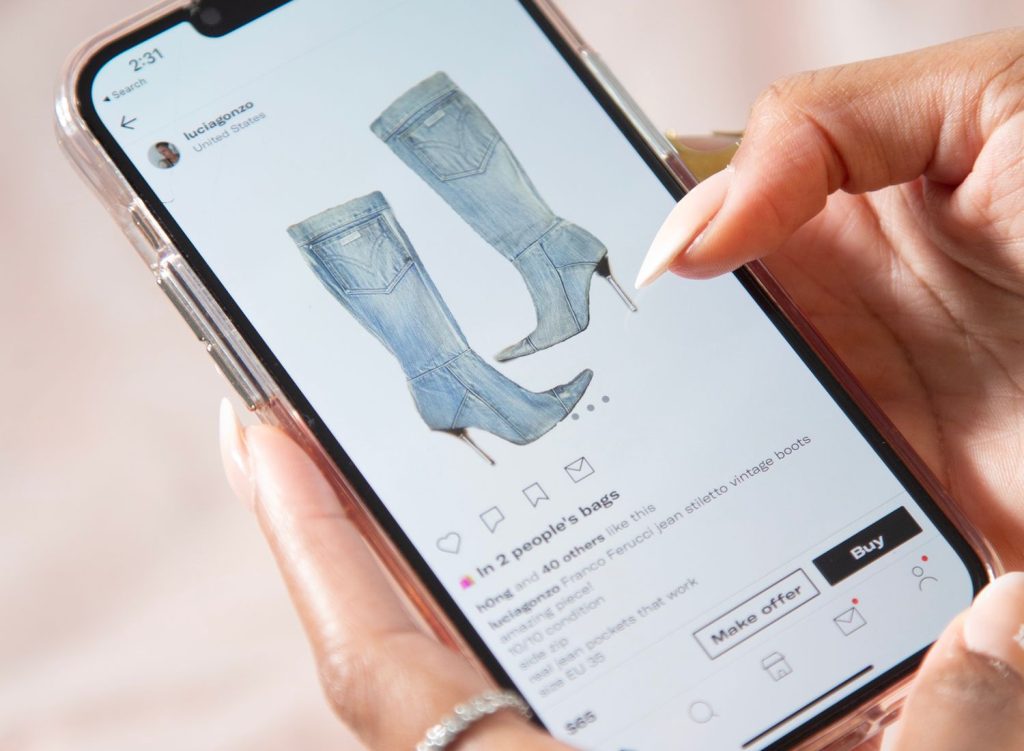
 What started as a commerce layer for a magazine quickly developed into a broader marketplace idea: a mobile-first, highly visual platform where users could list, style, promote and sell their own items directly to one another.
That social-first approach became central to Depop’s identity. Unlike more conventional online resale sites, Depop encouraged sellers to build individual storefronts, cultivate followers and present second-hand fashion as a form of self-expression.
The result was a marketplace that felt closer to a social media feed than a traditional ecommerce catalogue, with discovery driven by images, personal style and peer-to-peer interaction.
The model proved particularly attractive to younger shoppers who were looking for affordable, distinctive and more sustainable alternatives to mainstream fashion retail.
London calling
The company moved its headquarters to London in 2012, a shift that helped position the business at the centre of one of Europe’s most influential fashion, technology and creative markets. London became Depop’s operational base as it expanded internationally, later adding offices in Milan and New York.
The move also gave the business access to a deeper pool of fashion talent, technology expertise and investors at a time when mobile commerce was starting to reshape how younger consumers discovered and bought products.
Related Story

Early funding followed as Depop refined its proposition and grew its user base. Beckerman later moved from chief executive into a board role, while the management team continued to professionalise the company.
Maria Raga, who joined early in the business’s development, became chief executive in 2016 and oversaw a period of rapid international growth. Under her leadership, Depop became increasingly associated with Gen Z fashion culture, vintage shopping, independent sellers and the wider shift towards circular fashion.
By 2019, Depop had secured a $62m Series C investment led by General Atlantic to support expansion, particularly in the US, where the platform was gaining traction with fashion-conscious younger consumers. The investment highlighted how far the business had travelled from its origins as an incubator-backed Italian start-up. It had become one of the most closely watched names in resale, sitting at the intersection of ecommerce, social networking and sustainability.
Joining the Etsy community
Its profile rose further in 2021, when Etsy agreed to acquire Depop for $1.625bn. At the time, Etsy positioned the deal as a move that would extend its reach into the fast-growing fashion resale sector and deepen its exposure to Gen Z shoppers.
Depop was described as a community-led and purpose-driven marketplace for unique fashion, with gross merchandise sales of around $650m in 2020 and revenue of about $70m, both more than doubling year-on-year.

The deal also underlined the strategic value that larger marketplace operators saw in recommerce, where growth was being fuelled by affordability, individuality and sustainability concerns.
Under Etsy ownership, Depop continued to operate from London as a standalone marketplace with its own leadership, brand and culture. That independence was important because much of Depop’s appeal lay in its credibility with its user community.
Its marketplace was not simply a place to buy and sell used clothing; it had become a cultural platform for personal styling, small-scale entrepreneurship and circular fashion, with sellers often using the app to build followings and develop micro-businesses around curated wardrobes.
By the end of 2025, Depop had seven million active buyers, nearly 90 per cent of whom were under 34, alongside more than three million active sellers and approximately $1bn in annual gross merchandise sales.
Etsy’s ownership ultimately lasted less than five years. In February 2026, eBay agreed to buy Depop from Etsy for around $1.2bn in cash.
For eBay, the acquisition brings Depop’s fashion resale community into a much larger marketplace ecosystem while preserving its separate identity.
For Depop, it marks another major ownership shift in a 15-year history that has taken the company from an Italian incubator to a London-based global resale brand, then into Etsy’s portfolio and now under eBay.
The challenge will be to maintain the authenticity and community-led experience that made Depop distinctive, while using eBay’s scale in areas such as shipping, personalisation, compliance and trust to support the next phase of growth.
Click here to sign up to Retail Gazette‘s free daily email newsletter