
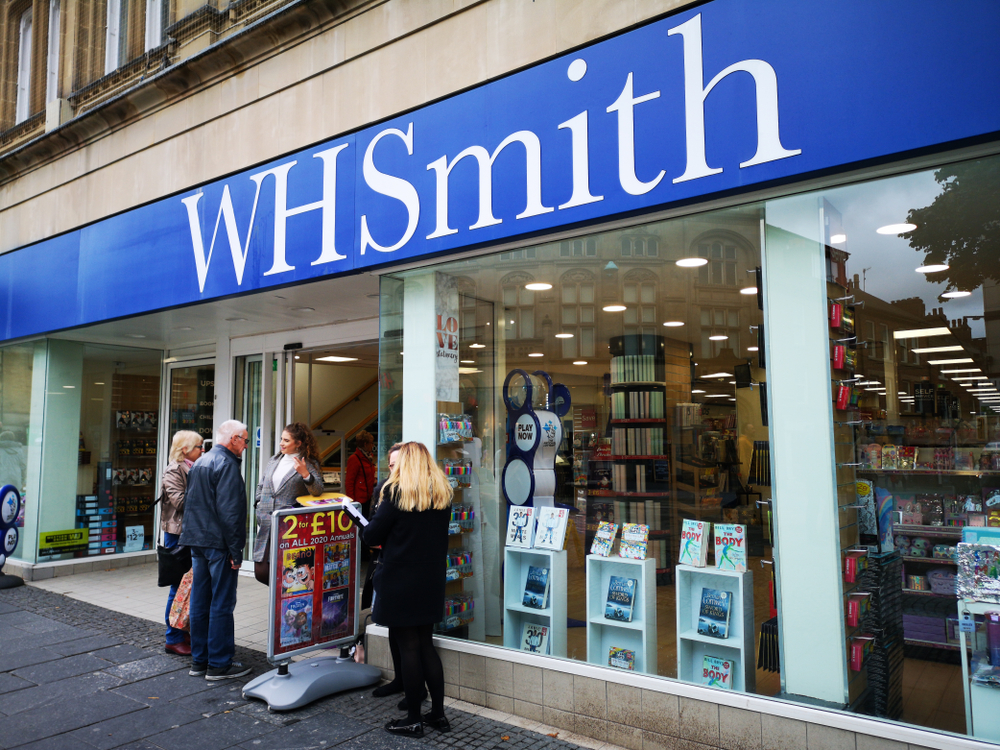
WHSmith confirmed this week that it has hoisted a ‘For Sale’ sign over its entire high street business, more than 230 years after it opened its first store.
The retailer known for its stationery, books and magazines said on Saturday that it was “exploring potential strategic options” for the business, including a possible sale of its 500 UK shops.
The high street stalwart is understood to have caught the eye of several suitors, including Bensons for Bed owner Alteri, Hobbycraft owner Modella Capital and HMV owner Doug Putman.
News of a possible sale comes as no surprise as the retailer has spent much of the last decade focused on growing its booming travel arm, which now accounts for 85% of its total profits.
As WHSmith revaluates the future of its high street business, Retail Gazette takes a look at why its selling the division and what’s next for the British high street staple.
Fallen behind, or managed decline?

WHSmith’s high street division has been put on the backburner for several years as the retailer pursed growth with its more profitable travel arm.
The retailer’s chief executive Carl Cowling announced in 2023 that it would no longer pursue growth in the UK high street sector as it turned its investment onto opening stores in UK airports, hospitals and train stations, as well as expanding internationally.
While it may only account for 15% of the group’s business, the high street division turned over a tidy profit of £32m in the year to 31 August as sales fell further to £452m.
However, it’s still a fifth of its travel arm, which posted a 15% increase in pre-tax profit to £189m against revenues of £1.46bn.
Globaldata retail analyst Tash Van Boxel says WHSmith’s high street arm has “consistently pulled down group revenue over the last three years” and the retailer’s focus on travel “left its high street fascia to fall further behind”.
“WHSmith’s struggles in its high street arm have come amid slow reactions to weakening demand for its core offer, with consumers turning to discounters for stationery and greeting cards, unable to justify WHSmith’s higher price points,” she adds.
Rising cost pressures ahead of Rachel Reeves’ tax hikes in April is thought to be a major contributing factor in WHSmith exploring its options for its long-neglected high street business now.
The retailer confirmed last week that it would be pulling the shutters down on 17 of its stores across the UK in the coming months as part of its ongoing restructuring strategy.
By contrast, it is planning to open around 40 new travel stores this financial year.
JDM CEO Jonathan De Mello notes that WHSmith has “always been a tale of two companies: the travel business and the high street business”.
“The high street business has always been declining because, structurally, a lot of the products that they were selling are substitutable,” he says, explaining many of its items can be bought elsewhere.
Retail analyst Nick Bubb echoes this, saying that it “makes sense” for WHSmith to explore a sale of its high street business as it has “less and less in common now with the travel stores, focusing on food and drink and travel accessories” alongside books.
“The logic of running them as separate businesses in the first place was that the mature high street chain would be run as a cash cow to invest in the growth of the lucrative airport stores etc – and that approach has worked pretty well,” he explains.
A high street staple
WHSmith has been a stalwart of UK high streets for 230 years.
Its longevity has even been mocked on social media by multiple accounts, including former Twitter parody account @WHS_Carpet which regularly posted pictures of its messy stores and confusing visual merchandising.
Bubb says that the retailer’s strategy to offset the persistent structural decline in high street “has been to cut costs to the bone”. He says that, as a result, the retailer’s high street stores are “not a pretty sight, and arguably devalue the WHSmith brand seen elsewhere by customers”.
Similarly, CEO of Savvy Marketing Catherine Shuttleworth argues: “It’s amazing they are still there when you think about the categories they’re in that have been completely changed by technology”, referring to the rise of streaming services and online retailers.
While the high street arm hasn’t played a key role in WHSmith’s growth plan, the retail giant has made some effort to rejuvenate its high street business in recent years.
WHSmith, which offers Post Office services in over 200 stores, expanded its Toys ‘R’ Us shop-in-shops last year, taking the total number of stores selling toys to 76.
It also brought back vinyl records into 80 of its stores last year in response to growing customer demand for the format.
The retailer also trailed a mini-rebrand at the tail end of 2023 across 10 of its stores, renaming the branches to ‘WHS’.
The retailer said at the time that the new store signs, which had space to advertise books, stationery, greeting cards, newspapers and “convenience”, were designed to raise awareness of the range of products it sold.
What’s next for WHSmith?
It’s understood that WHSmith is looking to secure in a deal in the coming months, however, the retailer warned that “there can be no certainty that any agreement will be reached”.
While the business has caught the eye of several private equity firms, Shuttleworth is sceptical on whether the retailer will find a suitable buyer.
“[WHSmith] have run the business very lean so it’s difficult to see how anybody else would extract value from it at this stage,” she says.

Bubb adds that while “there won’t be a long queue of people wanting to buy the high street business it has some growth points and attractions”, referring to its Funky Pigeon venture, Post Offices and Toys R Us concessions.
He says the strong cash flow “should appeal to scavenger private equity funds who can manage the decline”, adding “there is no reason why the high street business should die out”.
Similarly, Globaldata’s Van Boxel believes that a new owner will want to continue to operate the stores under the WHSmith fascia, “given its long history and the affection it is held in by consumers”.
However, she questions whether the new owner will want to take on and operate all 500 of its high street stores in the long term.
“WHSmith’s store portfolio has been well managed and has an average remaining lease length of under two years, meaning that buyers will not be committed to keep unprofitable stores open for long,” Van Boxel notes.
Whether a sale will go ahead is still unknown, but one thing for sure is that WHSmith is revaluating its future on the British high street.
Click here to sign up to Retail Gazette‘s free daily email newsletter