


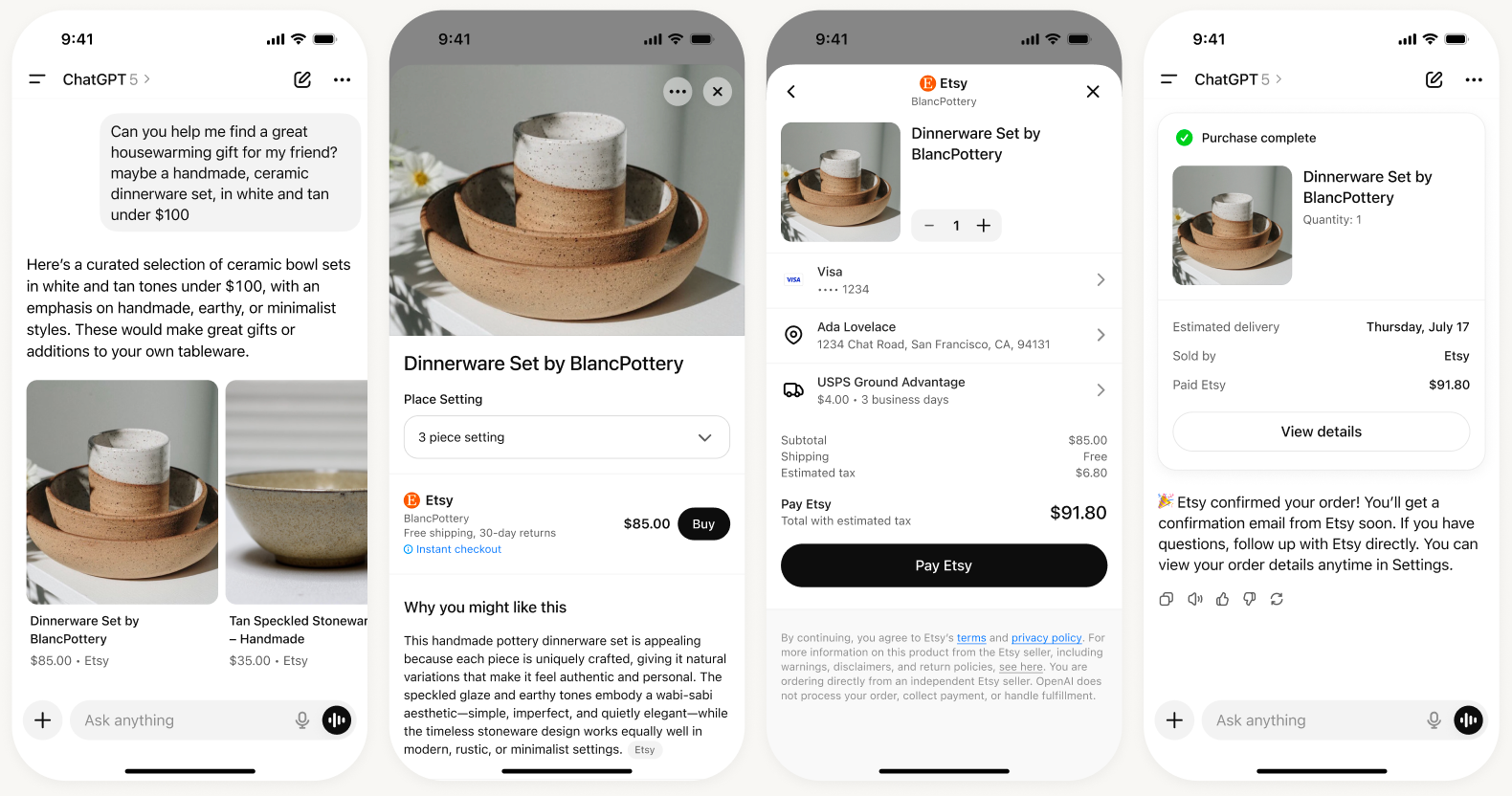
OpenAI has scaled back its plans to turn ChatGPT into a fully integrated shopping destination, marking a significant shift in its ambitions to reshape online commerce.
The AI giant had previously launched an ‘Instant Checkout’ feature that allowed users to browse products and complete purchases directly within the ChatGPT interface. The initiative, unveiled last September, was developed in partnership with ecommerce platforms including Shopify and Etsy, with retailers such as Walmart and Target also involved.
However, OpenAI has now confirmed that it will move away from processing purchases inside the chatbot. Instead, users will be directed to connected third-party apps where they can enter payment details and complete transactions.
An OpenAI spokesperson said the company was “evolving its commerce strategy” to better align with how consumers and merchants actually shop.
“We are evolving our commerce strategy within ChatGPT to better meet merchants and users where they are,” the spokesperson said. “Instant checkout is transitioning to apps, where purchases can occur more seamlessly.”
Shopping discovery remains strong, but conversion lags
The change reflects a broader reality facing AI-driven commerce: consumers appear comfortable using chatbots for product discovery, but far less inclined to complete transactions within them.
According to reporting by The Information, OpenAI’s internal data showed that while many users relied on ChatGPT to research products, relatively few were finalising purchases through the chatbot itself.
That insight appears to have been pivotal.
Retail discovery behaviour has been evolving rapidly as consumers increasingly turn to AI tools for advice, comparisons and recommendations. But when it comes to completing purchases, established ecommerce environments, from retailer websites to marketplace apps, still dominate.
For OpenAI, this behavioural gap made the complexity of running an integrated retail platform difficult to justify.
The hidden complexity of becoming a retailer
Operating a commerce platform involves far more than recommending products.
To function effectively as a transactional marketplace, ChatGPT would have needed to maintain live product data across millions of SKUs from thousands of merchants. Even minor discrepancies in pricing or stock availability could cause transactions to fail.
Beyond that, the company would also need to handle operational issues typically managed by retailers and marketplaces, including refunds, cancellations, fraud prevention and compliance with tax and consumer protection laws.
Those responsibilities add significant operational overhead for a company primarily focused on AI infrastructure.
As a result, routing purchases to third-party apps allows OpenAI to remain involved in the discovery process while avoiding the logistical burden of becoming a fully fledged commerce platform.
Merchants have been slow to embrace AI selling
Merchant adoption may also have played a role in the pivot.
Speaking at a recent investor conference, Shopify president Harley Finkelstein said that of the millions of merchants using Shopify, only around a dozen were actively using AI agents to sell products.
“The only reason it’s gated is we’re just waiting for the agent applications to continue to open the doors,” he said.
The comment suggests that while AI-driven commerce has attracted significant attention, practical adoption among merchants remains extremely limited.
Retailers are experimenting with AI tools across marketing, customer service and personalisation, but fully automated sales through AI agents are still in their infancy.
Not the end of AI-driven commerce
Despite the rollback, OpenAI’s ambitions in commerce are far from over.
The company claims ChatGPT now has around 700 million weekly active users, many of whom already use the platform for product research and recommendations.
Rather than becoming a transactional storefront itself, ChatGPT now appears more likely to act as a discovery layer that directs consumers toward existing ecommerce platforms.
Competition in this space is also intensifying. Meta is reportedly testing its own AI shopping research tools, designed to help users compare products and brands through conversational queries.
AI is becoming an influential part of the discovery journey, even if it is not yet replacing traditional ecommerce platforms.
The business model of buying directly through AI chat may have stumbled for now. But the behaviour driving it is continuing to grow.
Click here to sign up to Retail Gazette‘s free daily email newsletter