


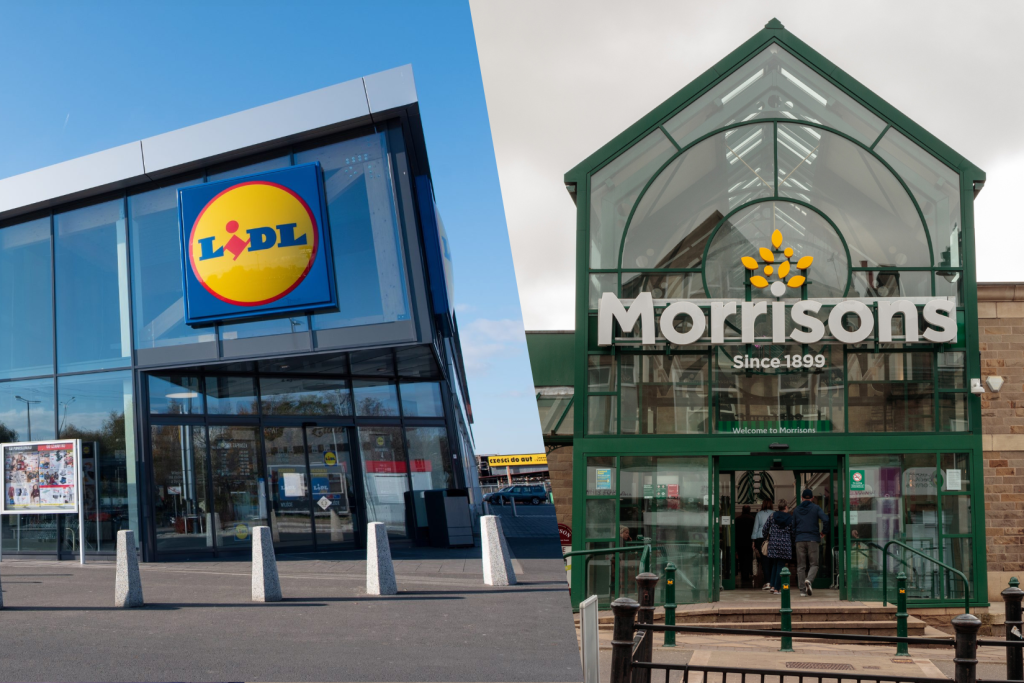
Some of Britain’s biggest supermarkets have called on the Competition and Markets Authority to change property rules that they claim give Aldi and Lidl an unfair advantage in local grocery markets.
Sainsbury’s, Morrisons and Iceland have urged the regulator to widen the scope of the Groceries Market Investigation Controlled Land Order, which prevents large grocery retailers from using restrictive property clauses to stop competitors opening nearby stores.
The CMA is currently assessing whether Aldi and Lidl should be designated as Large Grocery Retailers under the 2010 order.
The row centres on the German discounters’ classification as “limited assortment discounters”, a status that has historically kept them outside the rules applying to the likes of Tesco, Sainsbury’s, Morrisons, Asda and Waitrose.
According to The Times, Sainsbury’s warned in a submission to the CMA that there was a “serious risk” competition was “less effective than it could be”, arguing that Aldi and Lidl had an “asymmetric ability” to restrict rival entry and expansion in local markets.
The supermarket said the impact of this “regulatory gap” could become more significant as the discounters continue to grow their share of the UK grocery market.
Morrisons also backed a change to the rules, arguing that Aldi and Lidl’s combined market share has increased from less than three per cent when the regime was first created to around 20 per cent today.
The supermarket said widening the rules was needed to create a “level playing field”, and argued that the discounters could no longer be seen as uniquely low-price operators given the rise of price-matching schemes across the wider grocery sector.
Iceland has also pushed for reform. Its chief executive Richard Walker has previously claimed Britain’s competition rules were “rigged” in favour of Aldi and Lidl.
However, Aldi has argued that its classification should remain unchanged, insisting its lower prices are only possible because of its limited range and simpler operating model.
In its own submission to the regulator, Aldi said it does not operate ecommerce, click and collect or home delivery services, and does not offer features such as butchery or fishmonger counters, pharmacies, cafés, 24-hour stores, tobacco or newspapers.
It also said its stores were significantly smaller than traditional supermarket sites, with a standard net sales area of around 1,230 square metres.
Sainsbury’s challenged that position, arguing Aldi’s standard store size was closer to 1,804 square metres and pointing out that the current rules define larger grocery stores as those with a net sales area of at least 1,000 square metres.
A decision against Aldi and Lidl could represent a significant setback for their expansion plans. Both discounters have laid out ambitious targets for new store openings, although the pair have also faced planning delays and local opposition.
The CMA opened its call for evidence in March and the consultation closed on 13 April. It is now considering whether either Aldi or Lidl meets the criteria to be designated as a Large Grocery Retailer under the controlled land order.
The dispute comes as competition in UK grocery intensifies, with traditional supermarkets attempting to defend market share against the continued rise of the discounters.
A ruling that brings Aldi and Lidl under the same controlled land rules as the major supermarkets would mark a major change in the competitive landscape, potentially limiting the use of restrictive property agreements as the discounters continue their push for new sites.
Click here to sign up to Retail Gazette‘s free daily email newsletter
















1 Comment. Leave new
Maybe if the “traditional” supermarkets concentrated more on competing with Aldi and Lidl’s price/quality/availability/shopping experience standards instead of moaning about definitions…..