

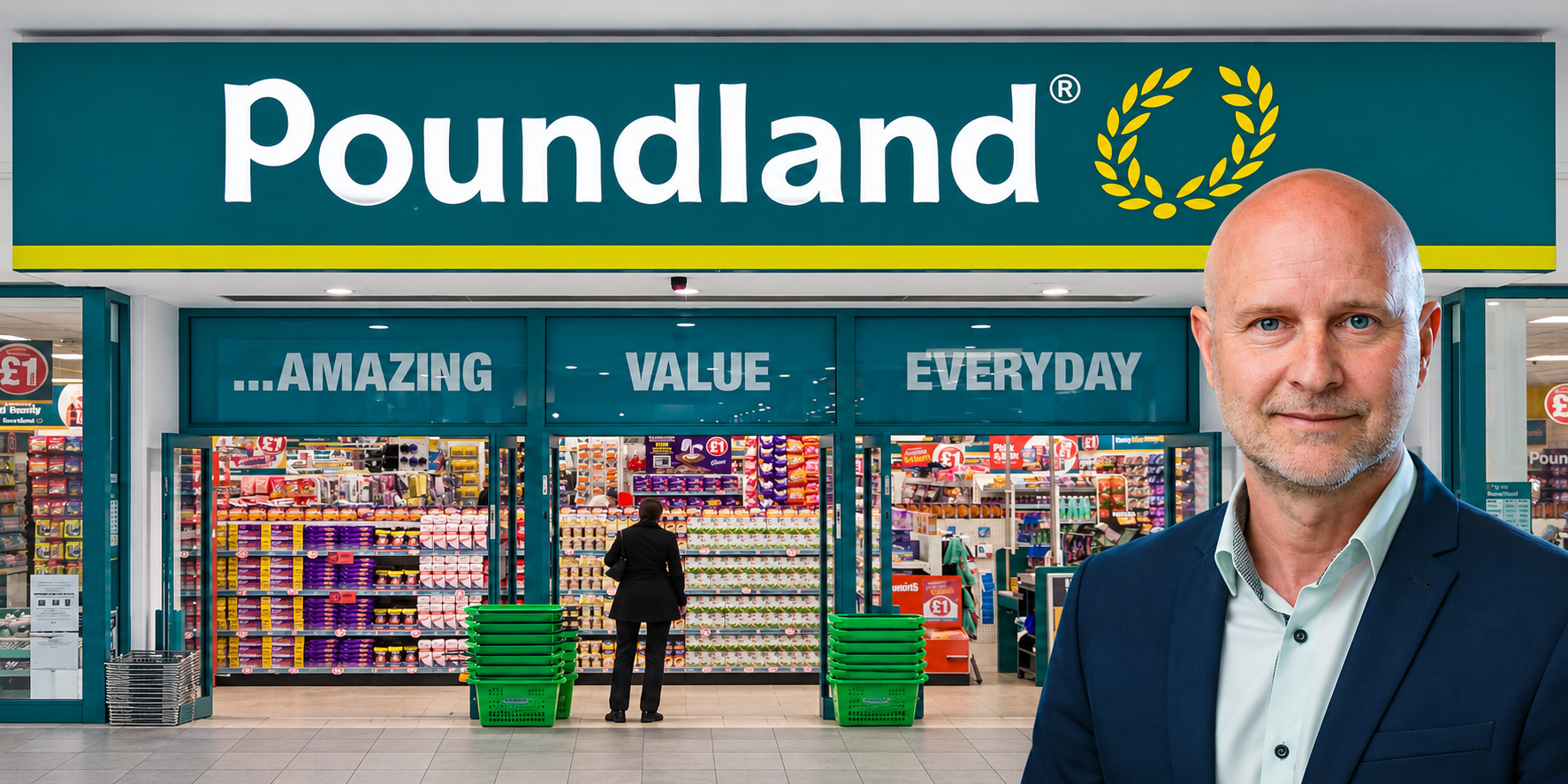
As Poundland enters administration just weeks before Christmas, Retail Gazette examines the challenges facing its administrators, the shockwaves being sent through its supply chain and whether there is still a commercially viable business to be rescued…
For a retailer, there is arguably no worse time to collapse into administration than a month before Christmas.
After months of uncertainty, political scrutiny and unsuccessful attempts to secure a rescue deal, Poundland has finally succumbed to administration, leaving thousands of employees, hundreds of stores and an extensive network of suppliers facing an uncertain future.
But what makes Poundland’s collapse particularly unusual is that it comes after a period in which it had reportedly made significant strides in improving its underlying financial performance.
Even Gordon Brothers, the investment firm that acquired the company for £1 last year, acknowledged that management and colleagues had delivered £100m in cost savings over the past 12 months.
The immediate challenge facing administrators will be keeping the business operational through the most important trading period of the year, while attempting to salvage as much value from the retailer as possible.
Doing so, however, may be considerably more complicated than simply keeping the doors open.
The race to save Christmas
The timing of Poundland’s administration presents a particularly difficult prospect for those now tasked with overseeing the business.
While keeping stores trading through Christmas would ordinarily be the commercially sensible decision, doing so requires the continued cooperation of thousands of employees and a supply chain that has already endured months of uncertainty.
Speaking to Retail Gazette, Ben Wright, managing partner UK&I at consultancy Argon & Co, says the timing is one of the most striking aspects of Poundland’s demise.
“Right before Christmas in the retail world is usually about the biggest no-no,” he says. “The obvious thing to do would be to try and keep things going for the next four to five weeks.”
Administrators have indicated that Poundland will continue trading, with the festive period potentially providing a window in which to secure a deal for all or parts of the business.
Katie James, partner at law firm Howes Percival, believes it could be January before the full extent of the administration becomes clear. “It is unlikely we will see any decisions regarding closures, redundancies and a sale before Christmas,” she says.
“The administrators will want to maximise the Christmas trading period, which requires staff and stock. However, I would expect something to be announced early in the New Year.”
For Poundland, which has historically relied on its seasonal proposition to drive footfall and sales, the importance of the coming weeks can’t be overstated.
However, Wright points out that the administrators’ ability to capitalise on peak trading will ultimately depend on their ability to maintain confidence among those responsible for keeping the company operational.
The mechanics of keeping Poundland alive
Much of the conversation surrounding Poundland’s collapse has centred on the value of its store estate and the appetite among rival retailers to acquire parts of the business.
Yet one of the more immediate challenges facing administrators is considerably less visible. How does it keep stock moving through the retailer’s supply chain?
While Poundland’s existing inventory represents an asset that could generate returns for creditors, realising that value is not necessarily straightforward.
As Wright explains, there is a significant distinction between the value of stock on a retailer’s balance sheet and what somebody else is prepared to pay for it.
“Stock has a value, but the debate will be what that value is, because it’s only got a value if you can sell it to someone,” he says.
“Will some of the other retailers see value in that stock and be able to take it? Some of it will have a shelf life, so it may not have anything like the value to somebody else that it currently does on Poundland’s books.”
Selling through inventory already sitting on shop floors is one thing. Extracting value from products elsewhere in Poundland’s distribution network presents an entirely different challenge.
“If you’ve got stock in a warehouse, it has a value, but who picks it in the warehouse? Who puts it onto a vehicle? Who drives it to the store and unloads it?” Wright asks.
If those responsible for carrying out these activities lack confidence that they will be paid, the administrators could find themselves sitting on significant quantities of stock that they are unable to readily monetise.
The challenge is particularly painful given the seasonal nature of some of Poundland’s proposition. Every day that Christmas stock spends sitting in a warehouse is another day lost from an already narrow selling window.
While administrators will be able to sell non-seasonal products beyond December, the commercial value of some festive ranges could deteriorate rapidly once Christmas has passed.
It’s a reminder that, for all the attention paid to Poundland’s financial position, the success of the administration will be determined in no small part by its ability to perform the basic functions of a retailer.
A shockwave through the supply chain
Beyond Poundland’s own workforce, the administration could have profound consequences for a network of manufacturers, wholesalers, logistics providers and other businesses.
For some suppliers, Poundland will represent a relatively small proportion of their overall sales. For others, it could be one of their largest customer accounts.
These businesses now face two separate challenges, one being the prospect of failing to recover money owed to them for goods already supplied and the other being the potential loss of a major revenue stream going forward.
There’s also an immediate decision to be made over whether to continue supplying the retailer.
“Do they carry on supplying or do they just hang on to their goods?” Wright asks. “Those are all the ramifications of this happening on 25 November. We’re already in peak trading. There are no winners in this, unfortunately.”
The complexity of Poundland’s financial arrangements adds another layer of confusion to the uncertainty facing suppliers, particularly those that are unsecured creditors.
James explains that the administrators have a duty to act in the best interests of creditors as a whole, but warns that not all creditors are equal, with secured creditors occupying an influential position in the process.
For smaller suppliers operating on already stretched margins, the repercussions could be particularly severe.
Molly Monks, personal finance and insolvency expert at Parker Walsh, warns: “For smaller suppliers operating on tight margins, losing a major customer and potentially millions of pounds in unpaid invoices could be extremely damaging.”
While some businesses further up the supply chain may have trade credit insurance in place, Wright warns that such protections will do little to fully offset the disruption caused by the collapse of a retailer of Poundland’s scale during peak trading.
Unlike during the Covid-19 pandemic, when exceptional circumstances prompted government-backed financial support for businesses, there is no comparable expectation of widespread emergency assistance.
Even for those suppliers that are sufficiently protected against bad debt, replacing the volumes of product ordinarily purchased by Poundland is unlikely to be an easy task.
The longer-term question is whether the relationships that underpin the retailer’s supply chain can be repaired, even if a buyer succeeds in rescuing the business.
Having already endured considerable uncertainty, prospective suppliers to a newly owned Poundland may place greater emphasis on payment terms, financial assurances and the creditworthiness of its new owner.
A change of ownership could help restore confidence, but rebuilding those relationships will be another challenge for any prospective purchaser.
Why Poundland’s collapse is so unusual
Retail administrations are hardly a new phenomenon on the British high street.
However, Wright believes the combination of factors that have culminated in Poundland’s collapse make it a particularly unusual case.
“We have a financial complexity, a timing complexity in terms of the proximity to Christmas, and a business that has shown it can be profitable and generate a return,” he says.
“I recognise a number of those things individually, but when you put them all into one case, that is pretty rare.”
One of the most striking aspects of Poundland’s demise is that it has come against a backdrop of apparent improvements in the retailer’s underlying trading performance.
Difficulties surrounding access to working capital and the retailer’s ability to replenish stock had become increasingly central to the debate over its future.
The collapse highlights the differences between operating a commercially viable retail proposition and having sufficient liquidity to sustain it.
Even a retailer that has successfully reduced its operating costs and improved profitability can quickly find itself in a precarious position if it is unable to finance the purchase of stock.
The consequences can also be self-perpetuating. A deterioration in availability can drive down sales, reducing the cash generated by the business and making it even harder to replenish its shelves.
For a discounter whose proposition is built around high volumes and relatively low price points, maintaining that flow of stock is particularly important.
Wright admits that, despite the well-publicised challenges facing Poundland, he did not necessarily anticipate the retailer collapsing before Christmas.
“I think this one was a tough one to predict,” he says.
“It looked like a rescue, and there is still money to be made in this space. Poundland has quite a strong trading model when it gets it right.”
Gordon Brothers, for its part, has defended its stewardship of the business, pointing to the £85m in new financing it provided and the £100m in cost savings delivered under its ownership.
The investment firm maintains that despite the improvements made to Poundland’s cost base, the retailer remained vulnerable to inflationary pressures and any downturn in sales or margins.
Nevertheless, the circumstances surrounding the retailer’s collapse raise questions about whether its demise was primarily the result of a fundamentally flawed retail proposition or a business that was unable to access the funding needed to sustain its turnaround.
The answer to that question could prove particularly important in determining whether there is still a viable business to be rescued.
Does administration improve Poundland’s chances of finding a buyer?
Despite the failure of Gordon Brothers’ three-month M&A process to secure a rescue deal, administration doesn’t necessarily spell the end of attempts to sell Poundland in its entirety.
The appointment of administrators fundamentally changes the dynamics of the sale process.
Gordon Brothers has confirmed that negotiations with interested parties, both for the whole business and for substantial portions of it, will continue under the administrators.
James believes the change in circumstances could make Poundland a more commercially attractive proposition to some prospective purchasers.
“Crucially, the administrators now decide whether an offer is acceptable or not,” she explains. “It is possible that they may decide to sell to one of the interested parties.”
A deal struck through administration could allow a prospective buyer to acquire the business and its assets without assuming many of the historical liabilities that might have complicated a solvent takeover, although certain obligations may still transfer.
“That can make a deal very attractive for a buyer and may well mean that they can offer a higher price,” James adds.
The question is whether a buyer sees greater value in preserving Poundland as a single retail business or acquiring its constituent parts.
While a number of potential purchasers have expressed interest in rescuing the retailer, Wright is sceptical about the prospect of Poundland emerging from administration in its current form.
“There’s always a bit of a yard sale with this stuff,” he says. “There’s a great store estate out there, there’ll be some great inventory and there’ll be some hugely valuable parts of this business that will be very attractive to other businesses.
“But I’m sure there are equally parts which are very unprofitable, with expensive stores or stores in the wrong places.”
For the administrators, the challenge will be determining whether the greatest value for creditors can be achieved by preserving the business as a going concern or selling its assets separately.
For Poundland’s employees, however, the difference between those two outcomes could be considerable.
Is there a future for the Poundland proposition?
Perhaps one of the bigger questions raised by Poundland’s collapse is what it says about the state of value retailing.
At a time when household budgets remain under pressure and shoppers continue to seek out cheaper alternatives, the demise of one of Britain’s most recognisable discount retailers might appear counterintuitive.
Yet Poundland’s struggles have played out against a backdrop of considerable success elsewhere in the value sector.
For Wright, the performance of businesses such as Home Bargains and TK Maxx demonstrates that there is still considerable appetite for retailers offering a broad assortment of products at compelling prices.
The challenge is ensuring that the breadth of that assortment constitutes a compelling reason to visit, rather than simply a collection of unrelated products.
“What are you going to Home Bargains for? Generally, the answer is absolutely anything,” he says. “But you’re getting it at a good price and it’s well stocked.”
He points to TK Maxx as another example of a retailer that has successfully turned the unpredictability of its assortment into part of its customer proposition.
“You don’t necessarily know what you’re going to get, but you know they’re going to have a lot of it and you know that there’s probably going to be something that you want.”
The ability to create a sense of discovery, similar to that offered by Lidl’s middle aisle, has become an increasingly valuable tool in driving physical store visits.
However, delivering that experience consistently requires considerable buying expertise, an efficient supply chain and the ability to respond quickly to changing consumer demand.
“They’re buying at the right price point, they’re seasonal, they’re in tune with the shoppers and they drive the footfall,” Wright explains.
For Poundland, whose identity has historically been closely associated with its iconic £1 price point, the question for any future owner will be how to deliver a sufficiently compelling proposition in a market that has become considerably more competitive.
That doesn’t necessarily mean narrowing its product range or abandoning the variety retail model.
It means ensuring that the assortment, pricing, availability and store experience work together to give shoppers a reason to visit.
The success of other retailers in the space suggests there’s no shortage of demand for such a proposition when it is executed effectively.
What does Poundland’s collapse mean for the wider high street?
Poundland’s demise inevitably raises wider questions about the health of the British high street.
The potential loss of hundreds of stores would leave significant gaps in shopping centres and town centres across the country, particularly in communities where affordable everyday essentials are an important part of the local retail offer.
However, Wright cautions against interpreting Poundland’s administration as evidence that traditional bricks-and-mortar retail is fundamentally broken.
“The high street is, of course, changing. This is not new news,” he says.
“The outcome that we’re probably going to see with Poundland is hard to take in a positive light, but there are lots of positive examples on the high street where the consumer requirement and the service provision from the retailer align brilliantly.”
For all the structural pressures facing the sector, Wright remains optimistic about the prospects for retailers that successfully align their operating models with what consumers want.
Poundland’s collapse may ultimately serve as a reminder that a recognisable brand, an established customer base and even an improving trading performance are not necessarily enough to guarantee a retailer’s survival.
Without the financial and operational infrastructure to support that proposition, the foundations of even the most familiar high street business can quickly unravel.
For now, the administrators’ immediate priority will be keeping Poundland trading through Christmas, preserving the value that remains in the business and determining which parts of it have a viable future.
Whether that future involves the survival of Poundland as a national retailer, a significantly smaller incarnation of the business or the redistribution of its assets among competitors remains to be seen.
But with thousands of jobs, hundreds of stores and an extensive network of suppliers hanging in the balance, the repercussions of whatever comes next are likely to be felt across the retail industry well into 2027.
Click here to sign up to Retail Gazette‘s free daily email newsletter