

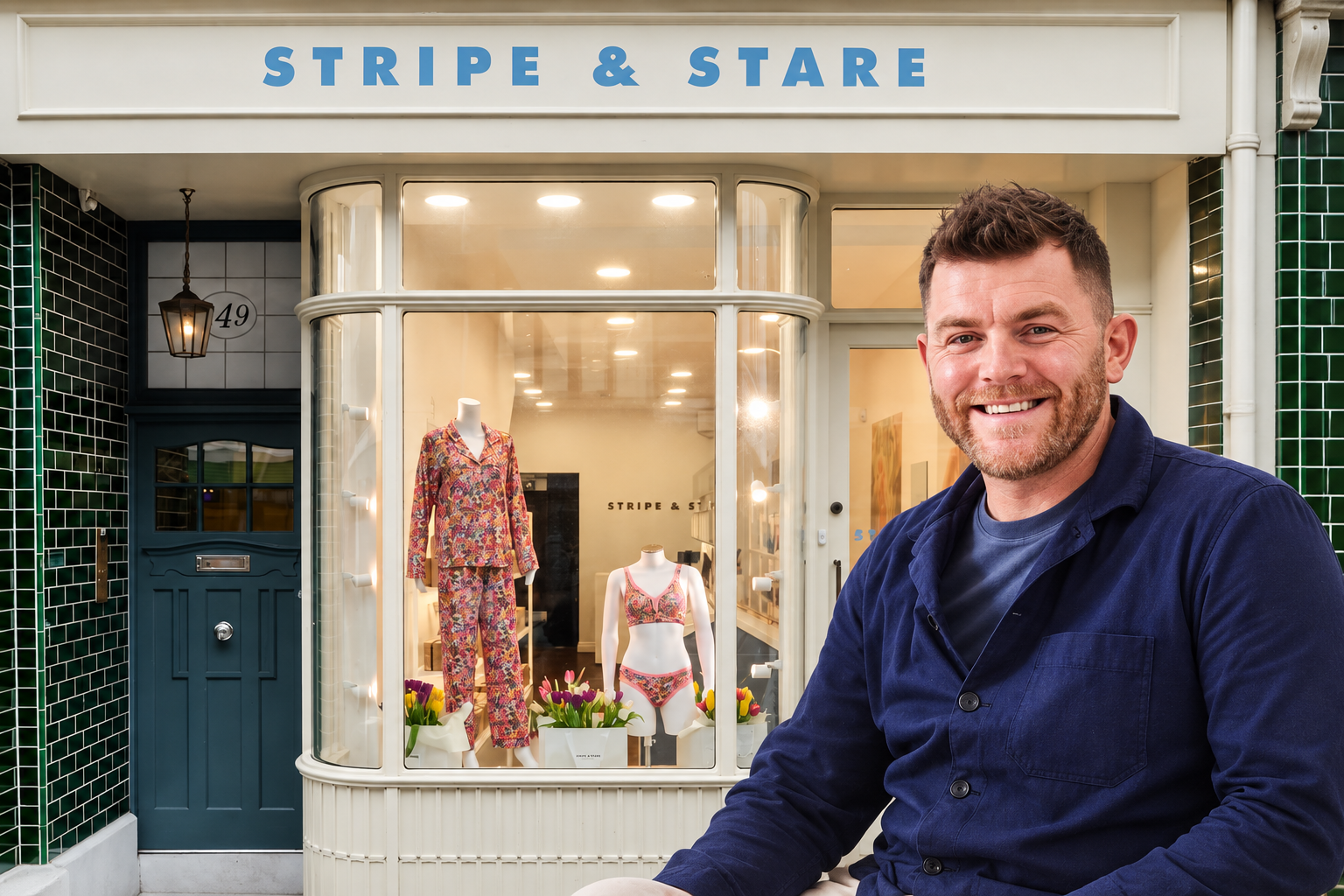
Stripe & Stare has grown from roughly £4m to around £15m in sales in little more than two years. Growth director Andrew Boddy tells Retail Gazette why diversifying beyond Meta and Google, building a long-term brand platform and taking a more realistic view of women’s lives are central to its next phase of growth…
Stripe & Stare has been on an intense journey of growth. Sales have almost quadrupled in little more than two years, growing from roughly £4m to around £15m. For growth director Andrew Boddy, however, the more interesting challenge now is not squeezing more from the channels that have already worked, but how to build a brand that consumers know before they ever start searching for underwear.
“When I joined, it was Google and Meta,” he says. “Rather than be too reliant on things, we diversified.”
The shift has taken Stripe & Stare into podcasts, catalogues, affiliates, creators, television and, increasingly, streaming and video. Performance marketing remains important, but Boddy’s view is that the business has reached a point where acquisition efficiency alone won’t deliver the next stage of growth.
Stripe & Stare has become good at converting customers once they enter its orbit, but the bigger problem is that too few people know the brand exists in the first place.
“We’ve got the confidence now that the product’s good and customers love us once they’re in our world,” he says. “We just didn’t have enough people in our world who were aware of our world.”
That diagnosis has shaped both its media strategy and its creative direction. Boddy, whose career has included spells at lastminute.com, Net-a-Porter, Mr & Mrs Smith, Eve Sleep and Monsoon Accessorize, says working across established brands taught him that long-term growth requires more than simply optimising a paid social account.
“When you’ve been at all these big brands, it’s hard not to absorb what makes a recognised brand,” he says.
It’s a lesson Stripe & Stare is now trying to apply at a very different scale. Boddy says the business has been growing at around 40 per cent year on year, but as it expanded, the risks of remaining overly dependent on Google and Meta became increasingly obvious. The answer was to make them part of a broader mix.
“We do podcasts, we do podcast advertising, we do catalogues. Google and Meta are still part of the mix, we’ve got affiliates, influencers are a much bigger piece of the pie now, and we’ve got TV there,” he says.
The decisions behind that expansion are grounded in customer and media-consumption data rather than a desire simply to appear in more places. Stripe & Stare uses brand tracking to understand both the demographic it wants to reach and where those people spend their time. That research pointed increasingly towards video and streaming, areas where the brand had comparatively little presence.
“We are an ageless product, but from a marketing lens you can’t target everyone who’s female because that would stretch us quite thin,” Boddy says. “We have a demographic that we go after, and then the brand tracking gives us an idea of the platforms, the media consumption and where those people are.”
The gap was surprising. Stripe & Stare was growing quickly without playing heavily in some of the channels where its audience was spending the most time. For Boddy, that made the investment case more straightforward.
“We’re growing consistently about 40 per cent on the year every year, and we’re not even where the mass majority of people are,” he says. “So what if we create something that is cut-through enough and punchy enough for a smaller scale-up brand like ourselves, but is in the place where, in terms of fishing, it’s a very rich pool of people?”
 Building a brand platform, not another campaign
The result is For All of You, a positioning designed to move Stripe & Stare beyond the polished conventions of traditional underwear advertising. Boddy says the idea emerged partly from frustration with a category in which brands increasingly talk about confidence, inclusivity and authenticity while still presenting consumers with an immaculate version of femininity.
“Everyone talks a good game,” he says. “Everyone will say they’re for women. They’ll say they want to give you confidence or whatever it may be. And then the reality, the execution, how it comes to life, is perfection again. It’s amazing lighting. It’s an unbelievably glamorous Hollywood star. The reality is that’s just not how we live.”
Stripe & Stare’s answer is to focus instead on what Boddy calls the “multitudes” of women’s lives. The contradictions, frustrations, pressures and mundane moments that rarely make it into conventional lingerie advertising. Crucially, he doesn’t want For All of You to operate as a campaign that disappears once the media spend ends. The intention is to turn it into a platform that can shape the brand for several years.
“If we can build something that isn’t a campaign, but is a platform for us that can compound over two, three, four years, that is the goal,” he says.
That longer-term thinking is also designed to make the marketing operation more efficient. Rather than developing a completely new idea for every season, launch or partnership, the team can place those moments underneath a consistent point of view.
“Everything we do now, whether it’s with influencers or the digital platforms or on-site, is back to this women-of-multitudes, this For All of You thing,” Boddy says. “Hopefully over time we can have a really ownable asset and an ownable point of view rather than coming up with firefighting new campaigns.”
For all the emphasis on brand building, however, Boddy remains firmly performance-minded. Data visibility, unit economics and customer behaviour sit underneath the bigger creative bets, and he argues that challenger brands can sometimes overcomplicate the measurement question.
“There are lots of people who find measurement tricky and difficult, but for a business our size, you don’t need to make it complicated,” he says. “We can know if a podcast is working. You know if a TV ad is working. You know if Google is working.”
His preferred approach is deliberately channel agnostic. Judge everything against the same commercial standards, understand what is and isn’t delivering, and move spend accordingly.
“We can see what’s working, what’s not, and then place our bets on where to put the money.”
 Why creators now matter as much as performance channels
That discipline is increasingly being applied to creators, which have moved from a relatively minor part of the plan to what Boddy describes as a channel on a par with Meta and Google.
The brand is wary, however, of assuming that the biggest creator will necessarily be the most effective. Boddy is more interested in whether the relationship feels believable, whether the audience trusts the person and whether the partnership can build over time.
“If their Instagram account looks like a Formula One car in terms of all the brands and the advertising that they’re doing, then it’s probably like, this is just going to wash through,” he says.
That has pushed Stripe & Stare to look outside the obvious fashion universe and think more broadly about what underwear marketing through creators can be. There is a practical reason for that too: many people who love an underwear product do not necessarily want to pose publicly in it.
“How do you present a product that no one wants to show themselves in, but they all freaking love it?” Boddy asks.
For All of You gives the brand more freedom to answer that question by focusing on the lifestyle and emotional idea surrounding the product, rather than simply putting a creator in front of a camera in their underwear.
“We don’t need to see you launching yourself in your underwear,” he says. “Everyone knows what someone will look like in their underwear. That’s not what it’s about. It’s more about the message and the ethos behind it.”
The test, once again, is whether the activity compounds. “Does this help us with awareness? Does this reach the right people? Is the message consistent with what we’re doing? Can we build upon this?”
That same question is beginning to shape Stripe & Stare’s plans beyond media. The US already represents around 20 per cent of the business, Boddy says, and deeper international expansion is high on the agenda. He also sees potential for more physical retail following a six-month King’s Road pop-up, while events and partnerships could help bring the brand positioning into real life.
Ultimately, though, his ambition is less about any one channel than about mental availability. He wants Stripe & Stare to become one of the names consumers naturally think of when they think about underwear, alongside far larger incumbents such as M&S, Calvin Klein and Victoria’s Secret.
“The dream would be for us to be at least in the top three or four when you think about underwear,” he says.
Boddy believes there is room for a brand that sits apart from the overtly sexualised end of the category while still feeling contemporary, distinctive and desirable.
“There’s not this brand that doesn’t need to be overly sexualised,” he says. “It’s just a really lovely product that gets women and resonates. To be in that conversation is what I’d love us to be.”
For Stripe & Stare, the challenge now is to make the transition that many digital challengers struggle to achieve: from being very good at finding customers to becoming a brand that customers already know. That will require bigger awareness bets, broader reach and consistency of message, while maintaining the measurement discipline that helped drive the business this far.
Boddy sees little reason to temper the ambition.
“When you’ve got the confidence in the product and we’ve got the team and the execution and the messaging all aligned, there’s no reason why we couldn’t do that,” he says. “Top three – but maybe top spot would be the dream.”
Click here to sign up to Retail Gazette‘s free daily email newsletter