

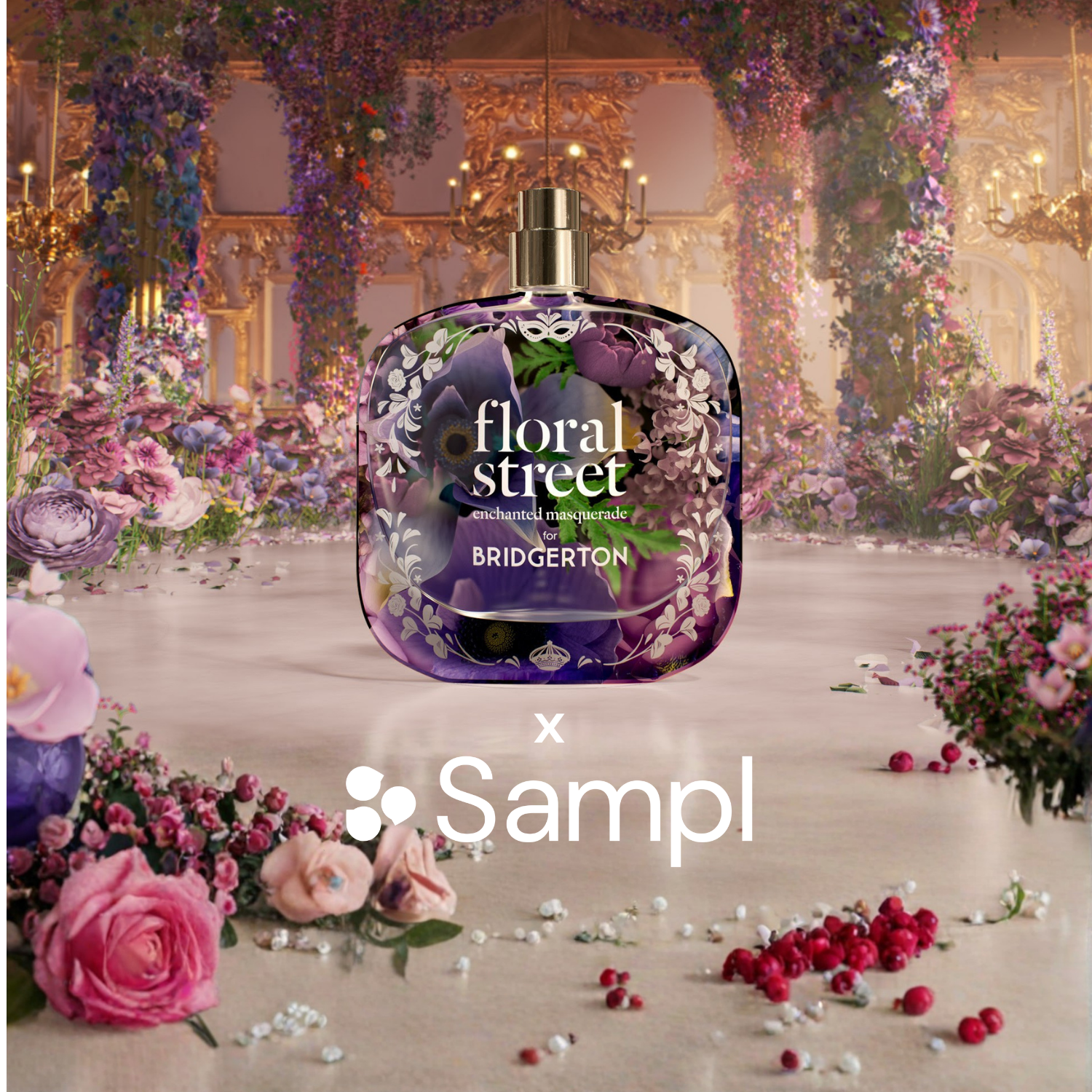
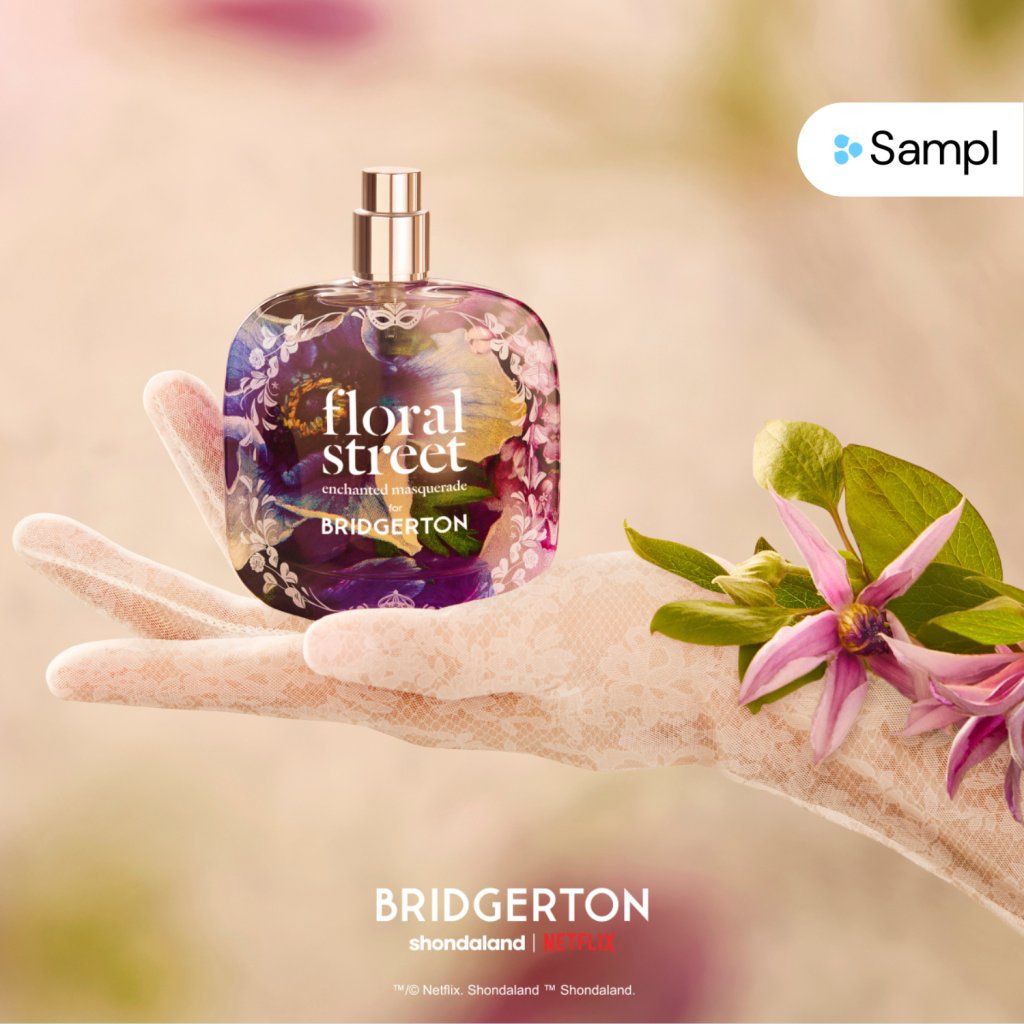
British perfumery brand Floral Street was tasked by Shondaland and Netflix to create an exclusive scent for Bridgerton.
The female-owned business worked on the project for two years.
The scent the brand came up with for the collaboration was titled ‘Enchanted Masquerade’ (the name was possibly inspired by the masquerade ball the main characters attend at the start of season four).
And it embodies the show’s Britishness, containing notes from flowers that one might find in any garden nationwide. Its top notes are made up of English pear, hazelnut and gardenia, with a Centifolia rose scent “lingering” underneath. The perfume also contains notes of skin musks and sweet cedarwood.
To advertise the new perfume, Floral Street teamed up with Sampl to use sampling to amplify its campaign impact. British Vogue and Glamour readers were able to request samples of the new perfume.
The move enabled the brand to have access to validated requests, tracked conversions, and clean subscriber data.
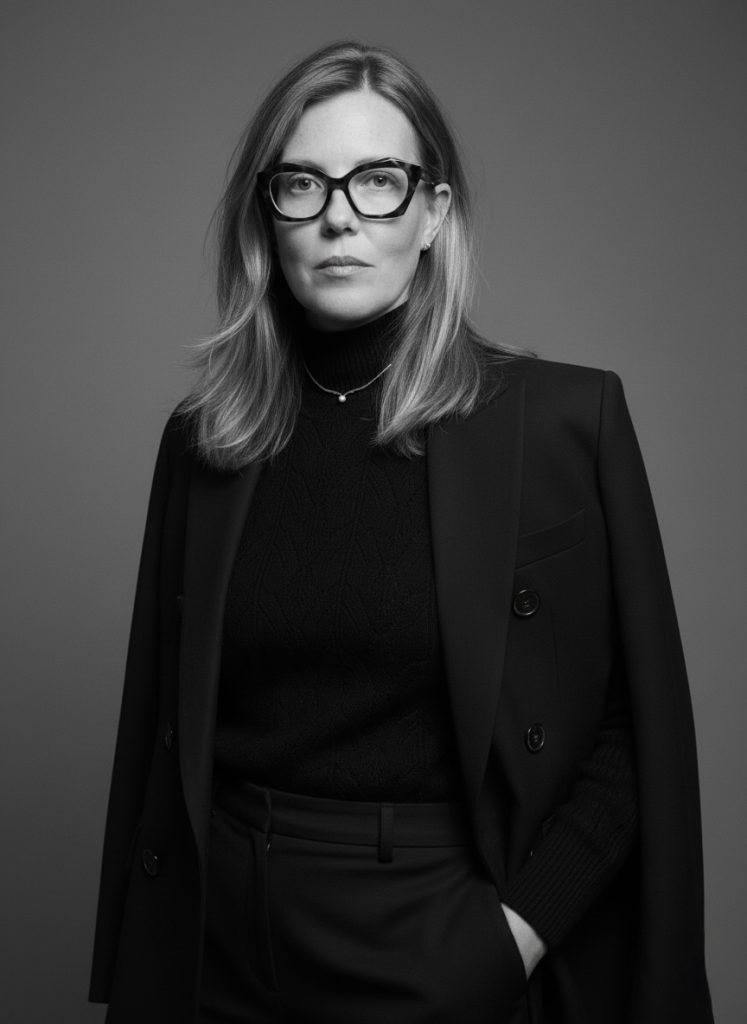
I sat down with Floral Street’s Anne-Noreen Keddy and Sampl’s Adam Wright to find out more.
Keddy felt that Bridgerton shared a lot of the values that are “quintessentially” Floral Street; both are British, both are kind of quirky, and both love a “twist”.
She explains that sampling had always been a part of Floral Street’s strategy, “from the very get-go,” and that as a small independent brand, they have to be extremely “clever” about how they drive brand awareness.
Adding that fragrance is a “personal experience” and that it’s about how it makes the wearer feel, and how it feels on their skin, as it can smell very different on different people.
Keddy says: “We always say at Floral Street that the last ingredient is you”.
“It’s [sampling] a really important way for us to get that brand on-hand experience, to have that one-on-one conversation with our consumers and get them to really understand the quality and beauty of our fragrances. And, we see a significant lift as a result of doing sampling”.
The brand has done “a lot” of uni sampling and beauty box sampling in the past. Keddy points out that a previous sampling campaign led to a 600% increase in sales.
She explains that Sampl were really great at understanding the brief when working on the campaign. Floral Street is known for being inclusive and doesn’t market its fragrances as being either male or female.
She says: “We don’t want a specific audience as such, but we do want an audience that is interested in beauty, that is interested in fragrance.
She adds that it was important they worked with a trustworthy entity that had “beauty authority” and was delighted to pair with Vogue and Glamour.
Adam Wright adds: “Whenever we do any sampling campaigns, we always start with a client brief. And Floral Street wanted credibility, wanted to associate themselves with an aspirational audience and wanted to make a big splash around a specific launch.
He explains that “Condé Nast’s reach and credibility build into that”.
Wright says: “They have genuine purchasing intent, they aren’t just a broadpanel, which is something we are really passionate about”.
He adds: “Anyone who is then receiving the product, we’re making sure that the brand is spending the money on people who are genuine customers or genuine people that can become customers rather than just kind of mass-sampling, which thankfully works very well.”
Keddy explains that they wanted to make sure their sampling campaign reached “high intent beauty lovers that buy into the category”.
She says: “The intent behind the campaign was to drive awareness of our brand among people who are already in their purchase cycle so that we could really make sure that we were part of their consideration set going forward.”
Wright adds: “Condé Nast have phenomonal reach, but they don’t just have the reach, they have the audience quality.”
He explains that Sampl are passionate about is making sure the samples end up in the hands of the target audience and anyone who is outside of that “eco-system” will be blocked.
He says: “We want to make the brand budget work as hard as possible.”
Related Story

According to Keddy, sampling is a “precision-targeted” activity if you get it right.
She explains that there are lots of industry studies which say return on investment for a sampling campaign is “incredibly significant.”
Floral Street’s media team reports that 73% of those who are sampled are more likely to buy post-trial, and 77% of consumers stated that if they brought a sample product from a company, then they were likely to go back and purchase more from that brand.
Sampling may also be preferred be a preferred method to social media when it comes to marketing.
Wright explains: “I think it kind of comes down to where someone is in their purchase journey or in their journey full stop, because with paid social, essentially it’s an interruption platform.
“You’re interrupting somebody who’s doing something else, and then you’re putting something in front of them. Whereas with something like this, they’re genuinely looking for beauty advice, they’re very beauty literate, and they’re in that, in that mode at the moment anyway.”
He highlights that there is a massive difference in intent between consumers actively requesting a sample and being given one. But there is also a difference between sampling and “mass awareness” campaigns.
According to Wright, it comes down to the purpose of the activity. Sampling is a conversion-based activity, and therefore, brands want high conversion rates.
He says: “From my experience, sampling is a really effective way to do that. And, social is kind of a brand awareness driver, so the expectations in terms of return investment are different.”
Keddy explains that they are means of tracking sample requests to sales. However, it is still early days for the Enchanted Masquerade campaign as the purchasing cycle post-sample can be anywhere between 15 to 60 days.
She says: “But we have seen that this launch of Enchanted Masquerade has been really positive in general and it has delivered above our expectations in terms of the impact that it has had. So we’re super pleased about that.
Wright explains: “It depends on how you set up the campaign, DTC is actually a perfect route to be able to measure something like that. Now, if the brand is selling in-store as well as that, there are nuances and things between them, but digital sampling in particular allows you to close the loop in ways traditional sampling never really could.
“And I think that the way that we look at measuring it is the short-term sales impact, but with the longest purchase cycles, you have all of the CRM data. So it means that you can retarget or essentially keep that customer base engaged over a longer period of time as well.
Wright explains: “We see a lot of brands have this audience over long periods of time, and it stays as their most engaged audience. ”
Keddy adds: “Doing the activity like this with Sample allows us to broaden that fan base and to really capitalise on, you know, th the carefully crafted first party data so we can understand differences in terms of purchase behaviour or kind of demographics or all of that really important stuff that helps us and informs our communications going forward.”
And, while Floral Street doesn’t have any specific data on conversion rates for this campaign as of yet, Keddy showcases that early feedback from those who had received the limited edition scent had been overwhelmingly positive, with 94% of consumers stating that they “absolutely adore” the fragrance.
She added that 60% of those who had received a sample had never heard of the brand previously.
Keddy says: “It just brings you joy that you’re giving joy to other people. That’s what our brand is all about. It’s about: how do we help you be your best self today?
“And receiving that sample from Vogue and from Glamour brought a tincture of joy into people’s lives.”
Click here to sign up to Retail Gazette‘s free daily email newsletter