Superdry CEO Julian Dunkerton on what makes his stores industry-leading

Big InterviewFashionIn-Store

At Superdry’s immersive and multifaeceted flagship at 360-366 Oxford Street, founder and CEO Julian Dunkerton is proving a broader point about physical retail.

The store, positioned as “a new chapter on Oxford Street” and “a reimagined space, crafted with intention and built for the next era of Superdry&Co”, isn’t simply a refreshed flagship, but a practical expression of how the creative force behind Superdry believes stores now need to work.

Dunkerton is immersing shoppers in the spirit of Superdry through strategic brand environments, discovery spaces and destinations with a clear point of difference. For him, too many retailers have stripped out the very things that once made stores compelling.

“A lot of stores forget the experience,” he tells Retail Gazette. “Everything got pared back for a decade. They’ve made it very utilitarian, as if it’s just a practical reason you’re coming shopping.”

His argument is that if consumers can buy functional basics anywhere, stores have to offer something else. A stronger sense of identity, more visual impact and a more distinctive mix of product and concepts.

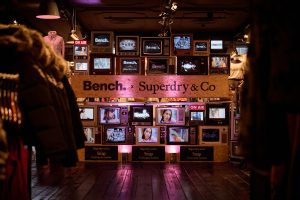
That thinking runs through the Oxford Street space, where unmistakably Superdry-centric product sits alongside additional retail propositions including a newly-launched Bench collaboration designed by Dunkerton himself and a crack team, and vintage product displays from brands such as Ralph Lauren and Carhartt. The intention is to give the store more breadth, more relevance and, crucially, more reasons for people to make the trip.

“I’m very conscious of cookie-cutter towns, cookie-cutter experiences,” says Dunkerton. “I think this generation is going to repel and rebel against the chain stores that are in every town, in every place, everywhere. So, my job is to make it a different experience.”

That doesn’t mean making the store different for the sake of it. Dunkerton’s approach is rooted in a clear commercial logic. If the modern high street is full of interchangeable spaces, retailers need a sharper offer to stand out.

“What I want to do is make sure that the consumer has a wonderful experience and makes the effort to come to Oxford Street,” he says.

Part of that strategy is to use the flagship as more than a standalone Superdry shop. Dunkerton wants it to function as a broader marketplace, bringing in adjacent brands and concepts that can widen its appeal and attract different customer groups.

“I’m hoping this area becomes a marketplace for up-and-coming young brands,” he says. “So there’s a real reason, if you’re in Surbiton, to go, ‘Why would I go to Oxford Street?’ Because I see all the same stores. No, let’s make this one different enough so consumers say, ‘I’m going to make a pilgrimage to Oxford Street to come here’.”

He is equally clear on the commercial role these additional concepts can play.

“Each area is its own sphere of influence. Our incredible new collaboration with Bench, or the vintage Ralph Lauren rooms, or the vintage Carhartt available; they’re all independently bringing their own consumer groups,” he says.


That belief in creating destination retail comes from experience. Dunkerton is not speaking as a distant chief executive or a founder wheeled out for a flagship relaunch. He’s speaking as someone who has spent decades building brands, shaping product and obsessing over how retail environments work.

Throughout the conversation, he returns repeatedly to the same point. His value lies in being able to combine creative instinct with commercial judgement (and an awful lot of good will within the industry).

“I’ve been doing this my whole life. I’m long enough in the tooth to know what the public want,” he says. “That’s what makes me slightly different.”

It’s a line that sums up how Dunkerton sees himself, and perhaps why he still has such a hands-on role in the business. In his view, too many retail businesses split creativity from commerce, weakening both in the process.

“Most brands or retailers will have a head of creative or a creative director who might not have any commercial skills at all,” he says. “So, the combining of the two is quite unique. It allows us to be agile, and also ensure that products aren’t diluted through people who don’t feel the passion for design and quality that I do.”

That mindset is visible throughout the Oxford Street flagship. The store isn’t designed as a neutral backdrop for product, but as a branded environment with distinct zones, clear visual identity and enough variation to keep customers moving through the space. It’s a maximalist space, where Superdry product jumps out from every possible angle. Dunkerton is trying to create a store people talk about, not simply a store people pass through.

For him, that’s especially important on Oxford Street, where retailers have to work harder than ever to justify the trip. “The next generations of shoppers with influence are going to rebel against chain stores. They’re sick of inauthentic experiences,” he says. “My job is to make coming to Superdry a different experience, and ensure that we’re the brand who captures your imagination.”

The flagship is also a reflection of how Dunkerton believes the Superdry brand should now be presented. Rather than relying on a single, uniform retail format, he is using Oxford Street to build something more layered and flexible. A flagship that can showcase the breadth of the business, accommodate new concepts and act as a platform for future partnerships.

He’s clear that this requires specialist talent and close collaboration, not just founder instinct.

“I work with incredible people,” he says. “I’m not stupid. I can’t do it all myself. I hunt out the best people to work with. I’ve been crafting these relationships for decades and I’m very picky about who we trust with the Superdry name.”
That same logic extends beyond visual merchandising and store design. Dunkerton talks about long-standing factory relationships, trusted internal teams and experienced colleagues who understand what good looks like. It’s an operating model based on speed, conviction and familiarity, rather than endless layers of approval.

“I no longer have to ask the board whether I’m able to do things. I get on and do it,” he says. “Not having a board to turn to and just being able to get on with things has allowed this process to be quick.”

It’s important to note, however, that Oxford Street is not being treated as a one-off showcase. Dunkerton sees it as part of a broader reset for the business, and as an example of how Superdry can use stores to gain momentum.

“I’m one of those people that only looks forward,” he says. “I never really look backwards because I’m always working out what’s next.”

What comes next, he suggests, is expansion. Dunkerton says Superdry plans to open 21 stores this year, while continuing to develop the kind of store environments now being tested at Oxford Street. The ambition isn’t simply to add more space, but to create more reasons for people to engage with the brand physically.

That means more destination-led thinking, more differentiation between stores and, potentially, more room for complementary concepts and partnerships that can broaden appeal without diluting the core brand.

For Dunkerton, Oxford Street is therefore more than a flagship relaunch. It’s a signal of how he wants Superdry to operate. Faster, more distinct, more confident in-store and more willing to give physical retail a stronger point of view.

Whilst the passion and care for Superdry is unmistakable when talking to Dunkerton, there’s a wider commercial ambition behind that thinking, too. “The next thing for me is to take us back to about three quarters of a billion turnover,” he says.

That’s a bold target, but it helps explain why so much weight is being placed on the role of stores. For Dunkerton, physical retail isn’t a legacy channel to be managed conservatively. It’s still a core strategic asset, provided it gives shoppers something they cannot get elsewhere.

And that, ultimately, is what the brand’s Oxford Street flagship is designed to demonstrate.

Click here to sign up to Retail Gazette‘s free daily email newsletter

Big InterviewFashionIn-Store

Leave a Reply

Your email address will not be published. Required fields are marked *

Fill out this field
Fill out this field
Please enter a valid email address.

Superdry CEO Julian Dunkerton on what makes his stores industry-leading

At Superdry’s immersive and multifaeceted flagship at 360-366 Oxford Street, founder and CEO Julian Dunkerton is proving a broader point about physical retail.

The store, positioned as “a new chapter on Oxford Street” and “a reimagined space, crafted with intention and built for the next era of Superdry&Co”, isn’t simply a refreshed flagship, but a practical expression of how the creative force behind Superdry believes stores now need to work.

Dunkerton is immersing shoppers in the spirit of Superdry through strategic brand environments, discovery spaces and destinations with a clear point of difference. For him, too many retailers have stripped out the very things that once made stores compelling.

“A lot of stores forget the experience,” he tells Retail Gazette. “Everything got pared back for a decade. They’ve made it very utilitarian, as if it’s just a practical reason you’re coming shopping.”

His argument is that if consumers can buy functional basics anywhere, stores have to offer something else. A stronger sense of identity, more visual impact and a more distinctive mix of product and concepts.

That thinking runs through the Oxford Street space, where unmistakably Superdry-centric product sits alongside additional retail propositions including a newly-launched Bench collaboration designed by Dunkerton himself and a crack team, and vintage product displays from brands such as Ralph Lauren and Carhartt. The intention is to give the store more breadth, more relevance and, crucially, more reasons for people to make the trip.

“I’m very conscious of cookie-cutter towns, cookie-cutter experiences,” says Dunkerton. “I think this generation is going to repel and rebel against the chain stores that are in every town, in every place, everywhere. So, my job is to make it a different experience.”

That doesn’t mean making the store different for the sake of it. Dunkerton’s approach is rooted in a clear commercial logic. If the modern high street is full of interchangeable spaces, retailers need a sharper offer to stand out.

“What I want to do is make sure that the consumer has a wonderful experience and makes the effort to come to Oxford Street,” he says.

Part of that strategy is to use the flagship as more than a standalone Superdry shop. Dunkerton wants it to function as a broader marketplace, bringing in adjacent brands and concepts that can widen its appeal and attract different customer groups.

“I’m hoping this area becomes a marketplace for up-and-coming young brands,” he says. “So there’s a real reason, if you’re in Surbiton, to go, ‘Why would I go to Oxford Street?’ Because I see all the same stores. No, let’s make this one different enough so consumers say, ‘I’m going to make a pilgrimage to Oxford Street to come here’.”

He is equally clear on the commercial role these additional concepts can play.

“Each area is its own sphere of influence. Our incredible new collaboration with Bench, or the vintage Ralph Lauren rooms, or the vintage Carhartt available; they’re all independently bringing their own consumer groups,” he says.


That belief in creating destination retail comes from experience. Dunkerton is not speaking as a distant chief executive or a founder wheeled out for a flagship relaunch. He’s speaking as someone who has spent decades building brands, shaping product and obsessing over how retail environments work.

Throughout the conversation, he returns repeatedly to the same point. His value lies in being able to combine creative instinct with commercial judgement (and an awful lot of good will within the industry).

“I’ve been doing this my whole life. I’m long enough in the tooth to know what the public want,” he says. “That’s what makes me slightly different.”

It’s a line that sums up how Dunkerton sees himself, and perhaps why he still has such a hands-on role in the business. In his view, too many retail businesses split creativity from commerce, weakening both in the process.

“Most brands or retailers will have a head of creative or a creative director who might not have any commercial skills at all,” he says. “So, the combining of the two is quite unique. It allows us to be agile, and also ensure that products aren’t diluted through people who don’t feel the passion for design and quality that I do.”

That mindset is visible throughout the Oxford Street flagship. The store isn’t designed as a neutral backdrop for product, but as a branded environment with distinct zones, clear visual identity and enough variation to keep customers moving through the space. It’s a maximalist space, where Superdry product jumps out from every possible angle. Dunkerton is trying to create a store people talk about, not simply a store people pass through.

For him, that’s especially important on Oxford Street, where retailers have to work harder than ever to justify the trip. “The next generations of shoppers with influence are going to rebel against chain stores. They’re sick of inauthentic experiences,” he says. “My job is to make coming to Superdry a different experience, and ensure that we’re the brand who captures your imagination.”

The flagship is also a reflection of how Dunkerton believes the Superdry brand should now be presented. Rather than relying on a single, uniform retail format, he is using Oxford Street to build something more layered and flexible. A flagship that can showcase the breadth of the business, accommodate new concepts and act as a platform for future partnerships.

He’s clear that this requires specialist talent and close collaboration, not just founder instinct.

“I work with incredible people,” he says. “I’m not stupid. I can’t do it all myself. I hunt out the best people to work with. I’ve been crafting these relationships for decades and I’m very picky about who we trust with the Superdry name.”

That same logic extends beyond visual merchandising and store design. Dunkerton talks about long-standing factory relationships, trusted internal teams and experienced colleagues who understand what good looks like. It’s an operating model based on speed, conviction and familiarity, rather than endless layers of approval.

“I no longer have to ask the board whether I’m able to do things. I get on and do it,” he says. “Not having a board to turn to and just being able to get on with things has allowed this process to be quick.”

It’s important to note, however, that Oxford Street is not being treated as a one-off showcase. Dunkerton sees it as part of a broader reset for the business, and as an example of how Superdry can use stores to gain momentum.

“I’m one of those people that only looks forward,” he says. “I never really look backwards because I’m always working out what’s next.”

What comes next, he suggests, is expansion. Dunkerton says Superdry plans to open 21 stores this year, while continuing to develop the kind of store environments now being tested at Oxford Street. The ambition isn’t simply to add more space, but to create more reasons for people to engage with the brand physically.

That means more destination-led thinking, more differentiation between stores and, potentially, more room for complementary concepts and partnerships that can broaden appeal without diluting the core brand.

For Dunkerton, Oxford Street is therefore more than a flagship relaunch. It’s a signal of how he wants Superdry to operate. Faster, more distinct, more confident in-store and more willing to give physical retail a stronger point of view.

Whilst the passion and care for Superdry is unmistakable when talking to Dunkerton, there’s a wider commercial ambition behind that thinking, too. “The next thing for me is to take us back to about three quarters of a billion turnover,” he says.

That’s a bold target, but it helps explain why so much weight is being placed on the role of stores. For Dunkerton, physical retail isn’t a legacy channel to be managed conservatively. It’s still a core strategic asset, provided it gives shoppers something they cannot get elsewhere.

And that, ultimately, is what the brand’s Oxford Street flagship is designed to demonstrate.

Click here to sign up to Retail Gazette‘s free daily email newsletter

Social


SUBSCRIBE TO OUR DAILY NEWSLETTER

  • This field is for validation purposes and should be left unchanged.
Big InterviewFashionIn-Store

Leave a Reply

Your email address will not be published. Required fields are marked *

Fill out this field
Fill out this field
Please enter a valid email address.

RELATED STORIES

Latest Feature


Menu


Close popup

Please enter the verification code sent to your email: