

Walmart this week announced its decision to expand drone delivery to another 150 stores in the US. However, more than just a flashy logistics update, it’s another sign that one of retail’s most futuristic ideas is edging closer to commercial reality.
The US retail giant is extending its drone service through partner Wing to major metro areas including Los Angeles, St Louis, Cincinnati and Miami, alongside previously announced launches in Houston, Orlando, Tampa and Charlotte.
By the end of 2027, Wing’s service is expected to be available from 270 Walmart stores, bringing around 40 million Americans within reach of ultra-fast aerial deliveries.
The technology has long fascinated retail leaders because it appears to answer one of the industry’s most persistent challenges, how to get goods to customers faster, more conveniently and at lower friction.
But the reality has been messier. Regulation, safety concerns, high operating costs and the limitations of early hardware have meant progress has often been slow. Plenty of retailers and delivery companies have tested the concept. Far fewer have managed to make it feel meaningful at scale.
That is why Walmart’s latest move may turn heads; the retail giant isn’t talking about a one-off pilot in a single market. It’s steadily building a wider service footprint and positioning drone delivery as part of its broader convenience proposition.
The offer is aimed squarely at those last-minute, high-urgency purchases that traditional ecommerce delivery struggles to serve profitably.
While Walmart is pushing the model deeper into the US mainstream, Amazon has been laying groundwork on this side of the Atlantic. In January, the retailer began flights out of its Darlington fulfilment centre, a key milestone in its efforts to bring Prime Air to the UK.
Deliveries are not yet under way, but the service is expected to launch officially in 2026, with Darlington set to become the first UK location to receive it.
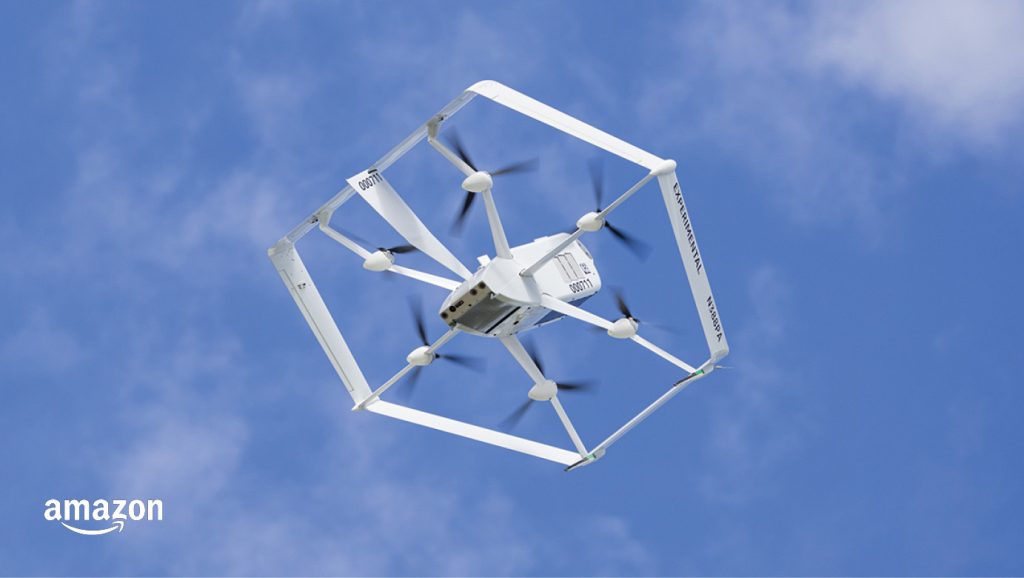
Amazon’s UK push centres on its latest MK30 drone, which the company says is quieter, more autonomous and better equipped to navigate real-world environments safely.
The drone uses advanced detect-and-avoid systems and machine learning models to identify hazards ranging from animals and physical obstacles to other aircraft. There’s also an independent monitoring computer designed to step in if the main flight control system detects irregularities, triggering a return-to-base procedure, if needed.
That level of technical sophistication gets to the heart of what has held drone delivery back for so long. For the concept to work commercially, retailers need a system that regulators trust, consumers accept and operations teams can rely on.
The conditions are, slowly, becoming more favourable. In the US, the Federal Aviation Administration has proposed new rules that would allow drone operators to fly beyond a human operator’s line of sight under certain conditions, without needing a special waiver each time.
That kind of regulatory easing could be critical in making drone delivery more scalable and less labour-intensive.
Without that shift, the economics are difficult. A McKinsey report last year estimated that drone delivery still cost around $13.50 per package, compared with about $1.90 for van delivery, largely because each drone still needed to be individually monitored by a human operator.
That cost gap is why drone delivery is unlikely to replace conventional fulfilment any time soon.
Vans remain better suited to bulk drops, denser routes and lower-margin baskets. Drone delivery’s role, at least for now, is narrower. It’s about speed, urgency and convenience, not broad substitution.
Even so, the commercial case doesn’t need to be universal to be compelling.
Walmart, for instance, offers the service free to Walmart+ members in covered areas, while non-members pay $19.99 per delivery. That pricing structure suggests the service is as much about customer retention and ecosystem value as it is about direct profit on each order.
The British retail market is already fiercely competitive on fulfilment, from same-day delivery and rapid services to click and collect and localised convenience propositions. If drone delivery does become viable in the UK, it will arrive in a market already primed to reward speed and convenience, but also deeply sensitive to cost.
That means retailers here will need to answer a tougher question than simply whether drones can fly. They will need to decide where the model genuinely improves the customer proposition enough to justify the investment, operational complexity and inevitable scrutiny.
Safety remains an obvious issue, particularly as high-profile incidents continue to cast a shadow over the wider sector. In the US, federal officials are investigating incidents involving Amazon drones in Texas and Arizona. Those kinds of events are a reminder that even as the technology improves, public trust can be fragile.
Noise, privacy and airspace congestion are also likely to become bigger talking points if drone activity increases in UK towns and cities. Amazon has stressed that its MK30 drone is about as quiet as an average van delivery, but public perception will matter almost as much as the decibel level itself.
And yet, despite all of those caveats, the direction of travel is becoming harder to ignore.
Retailers are under relentless pressure to differentiate on convenience. Customers are increasingly used to near-immediacy. The technology is improving. Regulators are moving, albeit carefully. And major players such as Walmart and Amazon are still investing, which suggests they see more than novelty value in the model.
So could 2026 be the year drone delivery finally starts to feel real in the UK?
Possibly, but only in a limited, early-stage sense.
It’s unlikely to be the year drones suddenly become a mainstream fulfilment option across British retail. The economics aren’t there yet, the regulatory environment is still evolving, and public acceptance cannot be taken for granted.
But 2026 could well be the year the idea moves from theory to genuine local reality, with the first UK consumers experiencing drone delivery not as a futuristic concept, but as a live retail service.
Walmart’s expansion shows that drone delivery is already broadly building real operational models around specific customer needs. If Amazon can translate that momentum into a credible UK launch, the industry may finally have its answer.
Not that drones are about to replace the van, but that they may at last find their place alongside it.
Click here to sign up to Retail Gazette‘s free daily email newsletter