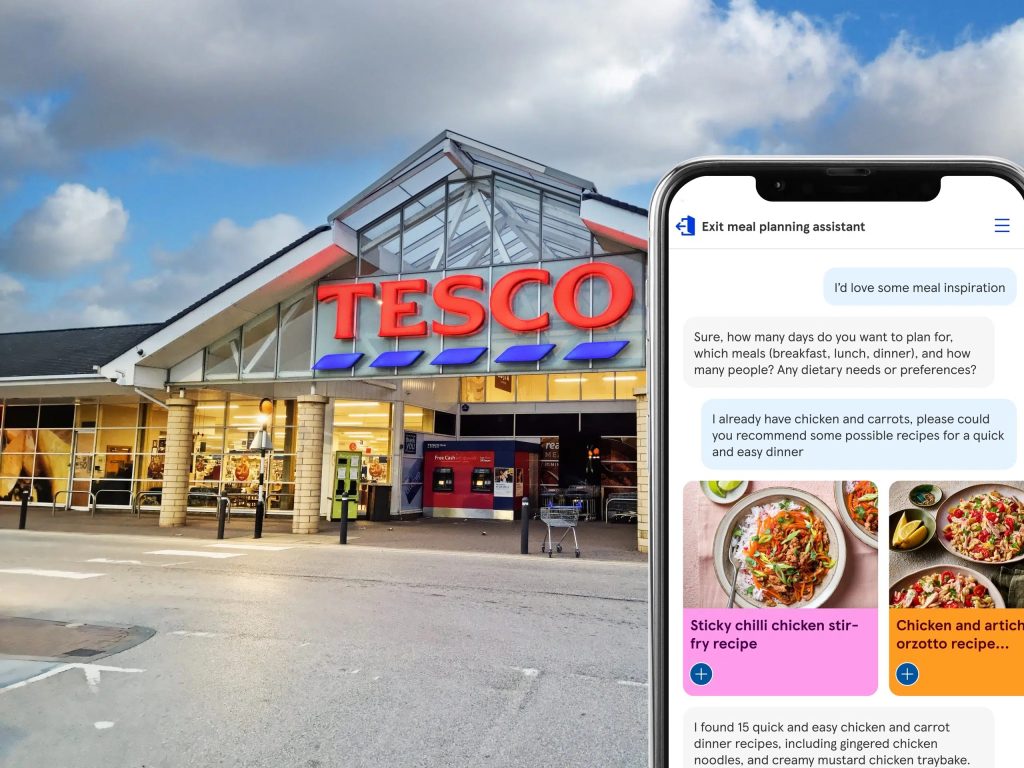



Currently, store recommendations in AI chats look like simple text responses. However, the evolution of AI interfaces will inevitably transform these mentions into interactive commercial elements. If today AI simply tells a user where to buy a product, tomorrow it will provide direct “add-to-cart” links.
We are already witnessing a fundamental shift in search architecture: Google is increasingly placing AI Overviews at the very top of the results page. This AI block pushes traditional organic results and even paid ads out of the user’s immediate view. When people get a complete answer instantly, they stop scrolling.
At Perspective, we believe that today, visibility alone isn’t enough – brands need AI recommendations to stay competitive. Many brands risk staying ‘invisible’ because their stores aren’t optimised for how modern algorithms think and decide.
For more than 17 years, Perspective’s experts have been helping brands build and scale ecommerce stores in an evolving digital landscape. In this article, our team explores how businesses can move beyond basic visibility, increase their chances of becoming the preferred answer to “where to buy,” and prepare for the growing role of AI-driven discovery in modern marketing strategy.
Why your store risks being “overlooked” by AI
Generative Engine Optimisation (GEO) mirrors the logical development of classic SEO, but with much higher stakes. In competitive niches, reaching the Top 10 of search results can take years of continuous effort – and with AI, the situation is identical. User behaviour is changing today.
If your store isn’t optimised for these new algorithms, AI will simply overlook you and pass your customers straight to a competitor. If a business chooses a ‘wait-and-see’ approach, it falls into the trap of delayed results. When AI-driven traffic becomes dominant in five years, it will be too late to start; you would need another five years just to catch up with the leaders who began today. GEO is a proactive game: you can either prepare your tech now or let your competitors take your customers later.
Early entry into GEO may offer a similar strategic advantage to adopting SEO in Google’s early years. The space is still relatively open, giving brands an opportunity to shape how AI systems discover and reference their content. Those who are first to adapt their websites to AI bot requirements will reap the rewards. Catching up to a leader in GEO will be much harder than in classic SEO due to the cumulative authority effect: the more AI mentions you now, the more it will trust you in the future. This is a direct opportunity to quickly capture market share from conservative competitors focused on legacy channels.
Barriers to implementation
Despite the benefits, we observe specific obstacles among our clients in medium and large e-commerce projects:
- Talent Turbulence
GEO results depend directly on time. It is not a quick fix, but a marathon. Internal company changes often stall progress. Team turnover leads to a loss of focus; new hires may spend months just learning AI optimisation tools. These gaps prevent GEO from becoming a systemic process, forcing companies to restart from scratch repeatedly.
- The Cost of “Business as Usual”
Many stakeholders still view GEO as an experiment rather than a market trend. They rely on traditional reports where 90% of traffic steadily comes from classic Google Search. This stalls investment in new channels. However, this position is risky: user behaviour is shifting faster than analytical reports can reflect.

What affects store visibility for AI bots?
Technical visibility for AI algorithms is based on several critical factors. The first and most basic is actual access to content.
Auditing access for AI crawlers
We have entered a period where AI crawlers are scanning resources at scale. Many businesses were technically unprepared for this load; sites simply couldn’t handle the request frequency and “crashed”. In response, admins began blocking AI spiders. While this was a necessary server defence at the time, it has now become a barrier to marketing.
Having worked on more than 100 successful e-commerce projects, Perspective’s experts have seen that many large websites still rely on legacy technical configurations that can limit access for emerging AI crawlers and generative search systems. Therefore, the first step to GEO is an access audit – ensuring your pages are not just live, but open to new types of bots.
AI visibility and javaScript
The second nuance is the technology stack. AI bots still struggle to recognise content generated via JavaScript. If your catalogue relies on dynamic scripts, a bot might see a blank page instead of product cards. Understanding how a machine “sees” your code is now a prerequisite for survival in AI search results.
In business terms: be extremely cautious with dynamic blocks. If information appears only after a specific user action, an AI crawler will likely miss it. What exactly is at risk?
- Pop-up content: If essential text or promo details appear in a pop-up, they don’t exist for the bot.
- Lazy Load: If product blocks load only upon scrolling, the bot (which doesn’t “scroll” like a human) will only see the first screen.
- Hidden Tabs: If data in a “Specifications” tab loads only after a click, that massive array of useful info remains ignored.
For AI, your site must be as “transparent” and static as possible at the moment of loading.
The role of schema markup in AI optimisation
Another critical aspect is Advanced Schema Markup. While most ecommerce projects use semantic markup, it is usually tuned specifically for Google’s requirements. For AI, this isn’t enough. Put simply, the markup must explicitly tell the AI where to find the price, the description, and the product images.
To help AI “comprehend” rather than just scan a page, additional lines of code are required. This allows the bot to instantly identify key data: exact model names, real-time pricing, stock availability, and authentic reviews. Only then can an AI assistant distinguish your product from competitors.
From robots.txt to llms.txt
For decades, robots.txt acted as the basic roadmap for search bots. You can see this on sites like Amazon or Argos by adding /robots.txt to their URL. It provides simple “Go/No-Go” instructions.
Based on emerging industry practices, we’re increasingly seeing llms.txt or llms-full.txt files. This is essentially the “younger brother” of robots.txt, designed specifically for Large Language Models. What’s the difference? While the old file simply allowed or denied entry, llms.txt acts as an executive summary of your site. It is a concise, AI-friendly guide to your content, helping bots like ChatGPT or Gemini bypass code clutter and grasp the essence of your offering immediately. This saves AI resources and increases your chances of being featured in accurate user responses.
AI ranking criteria: What does the machine want?
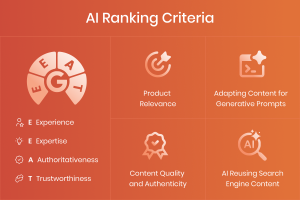
We have already covered the first point – visibility. The second is just as critical: if your store appears in AI results in the hundredth position, your chances of being seen by a customer are effectively zero. To avoid this, it is essential to understand the ranking criteria that determine which options the AI prioritises.
Product relevance
AI systems prioritise stores that clearly specialise in the type of product a user is searching for. They also evaluate availability, giving preference to retailers where the product is in stock and can be delivered without delay. This combination ensures that recommendations are both contextually accurate and immediately actionable for the user.
EEAT
Experience, Expertise, Authoritativeness, Trustworthiness (EEAT) is a set of criteria used to evaluate the quality and credibility of content or a company. Before recommending a store, a bot “studies” its reliability by evaluating return policies, shipping details, delivery conditions, including the exact origin of shipment. Reviews about the seller are a critical factor. The AI also analyses feedback from forums and other external sources to assess whether the seller is trustworthy or not. The AI acts as a personal advocate for the user, ensuring they won’t be scammed. Therefore, priority is given to sellers who demonstrate real user experience: live unboxing photos rather than 3D renders, or video reviews featuring real people rather than AI avatars. Already now, we recommend that eCommerce businesses actively encourage customers to leave reviews, written feedback, and even video testimonials directly on product pages. The user-generated content helps build trust and signals authenticity, which in turn improves how AI systems evaluate and rank your products in search results.
The AI will assume that this seller provides a stronger and more reliable user experience. To the algorithm, this is a signal of a real product and real accountability.
Adapting content for generative prompts
The third stage of optimisation is adapting content to user Intent and scenarios. Unlike old-school SEO, which lists attributes, GEO requires usage scenarios. AI interactions are inherently conversational and exploratory. Unlike Google, where users simply search for “where to buy,” AI behaves more like a trusted advisor, helping you choose, for example, the right laptop for studying. That is why it is important for your product page content to go beyond basic use cases and include comparisons with alternative options, clearly explaining why a newer product is better than an older one. AI tries to be a helpful conversationalist, so it looks for “human” arguments: “best value compared to competitors,” “ideal for video editing,” “optimised for students.” This is the only way your store will be recommended within a complex, multi-layered user query.
Content quality and authenticity
Modern AI models are paradoxically critical of content that looks machine-generated. For effective GEO, the priority is material created by humans, for humans.
In professional SEO circles, it is believed that if a text is more than 40% “robotic” in its phrasing, it becomes toxic to search engines. AI seeks unique experience, authorial style, and “human” logic. The machine wants to cite an expert, not its own echo. High-quality text today isn’t about “beautiful” sentences; it’s about whether the AI can find something original in your content that isn’t already in its own training data.
AI reusing search engine content
AI also pulls information from product feeds provided by aggregators because these feeds offer clean, structured, and up-to-date data about products – such as price, availability, specifications, and seller details. Unlike regular web pages, which require interpretation, product feeds are already organised in a format that machines can easily process, compare, and rank.
Conclusions
We are already seeing the transformation of Google Search with AI-powered direct answers (SGE). This is just the beginning. In the near future, we expect the inevitable commercialisation of this space. Eventually, AI responses will become the new “premium” ad space, where priority belongs to brands technically prepared for GEO.
Today, the generative response market is still largely untapped, offering a unique opportunity to capture the audience of more conservative competitors. Perspective’s experts believe that companies that invest in transformation and adapt their digital infrastructure now will become the “authorities” that AI models cite by default. The rest will be left playing catch-up in a world where the old rules of SEO no longer apply.
Click here to sign up to Retail Gazette‘s free daily email newsletter