


Five years on from its high street exit, what will success look like for Topshop’s John Lewis partnership?
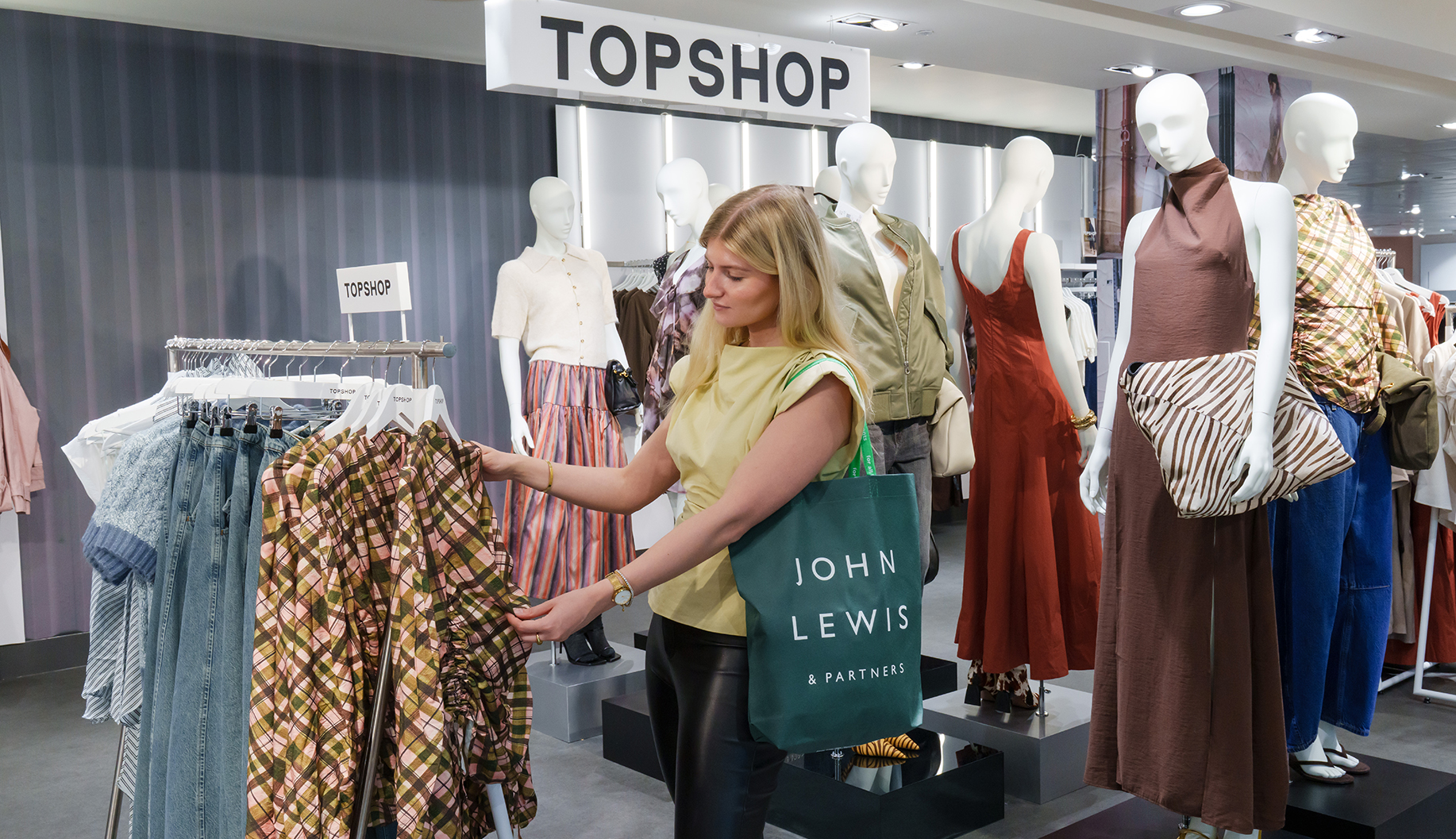
Last week, Topshop returned to the high street with a launch in 32 John Lewis stores nationwide, marking the brand’s most significant bricks and mortar debut since its collapse in 2021.
In total, with Topman also debuting in seven locations, a curated range of around 130 styles across womenswear, menswear, and footwear will be available in-store.
Established in 1964, Topshop began its life as a small fashion department within Peter Robinson store in Sheffield, before later evolving into a standalone high-street fashion brand. At its peak in the mid 2010s, Topshop was reported to be generating over £1bn in annual sales with profits upwards of £100m.
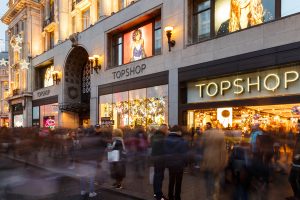
However, by 2018 Topshop and Topman businesses together reported a full-year pre-tax loss of about £505m, while sales had dropped to a mere £847m. On 30 November 2020, parent company Arcadia Group went into administration, seeing all physical Topshop shops closed, effectively ending its traditional high-street presence by early 2021.
Just weeks later, 1 February 2021, Asos acquired the Topshop, Topman, Miss Selfridge and HIIT brands out of administration for £265m, in a deal that did not include the physical stores.
Of course, while the London fashion label in the past few years has continued to trade online through Asos, its return to the high street – first via luxury department store Liberty last summer and now through John Lewis stores across the country – has been long-awaited.
“Everyone’s really nostalgic about Topshop,” said former Asos head of retail and founder of Flourish Retail, Sarah Johnson.
“So even though it’s been available on Asos since 2021, I think everyone has a fondness for being able to go into stores.
“There’s community and the sense of experience that you had from the brick-and-mortar stores… there’s more excitement now, because its coming back in physical form.”
Johnson describes the John Lewis rollout as a “shrewd” decision, in comparison to its Liberty debut. The scale of 32 store launch makes the brand more accessible for shoppers around the country, while its price positioning keeps it within reach of a broad customer base.
“It increases footfall for them. John Lewis should be able to attract the original demographic of customers, which will also have teenagers – it’ll bring more people in.”
The partnership also reflects a deliberate shift in positioning. “The Liberty range will have been a slightly different one to John Lewis,” says Johnson.
“The John Lewis range will be a bit more commercial because of the customer base that they’ve got, as they will be appealing to a broader audience with a different level of disposable income.
“Also, obviously Liberty is only one store and one destination, whereas this is going across the country in terms of the number of John Lewis stores, and therefore it needs to appeal to all of the demographics across those markets.”
A return to a different high street
The high-street is experiencing its own type of comeback, following retail outperforming all other types of commercial property in 2025, with 9.2 per cent returns on investments in the year to September, property giant Knight Frank said. This is ahead of industrial properties, at 9.1 per cent and offices at 3.2 per cent.
However, the return of Topshop, as Global Data apparel analyst Chloe Tedford-Jones says, has been anything but straightforward.
“Topshop’s comeback is calculated and measured,” Tedford-Jones says. “It leverages nostalgia and curated product lines to reconnect with millennial and older Gen Z shoppers, rather than trying to dominate the high street as it once did.
She warns: “It’s a smart relaunch, but its ultimate success hinges on effective storytelling and marketing amplification.”
While the emotional pull of Topshop may remain strong in the hearts of its consumers, it would be a mistake, say both Johnson and Tedford-Jones, to assume the fashion brand would be returning to the same retail landscape it left five years ago.
Half a decade on from its exit, the high street is leaner and less forgiving. Pandemic lockdowns reshaped footfall patterns, while inflationary pressures and the cost-of-living crisis have squeezed discretionary spend. At the same time, digital-first operators and ultra-fast fashion players have made competition even more intense.
For many, the collapse of Arcadia Group marked the end of an era, and a huge blow to physical retail following the closure of 300 stores in the UK and an additional 210 worldwide. Since then, other names have struggled to hold their ground. Oasis and Warehouse have disappeared from physical retail, while in 2026 alone Russell & Bromley, LK Bennett and Quiz have all filed for administration, citing economic pressures.
It is then, Tedford-Jones says, not a coincidence that Topshop is choosing to first return through wholesale rather than standalone stores.
“Wholesale allows Topshop to test demand with lower operational risk and cost, while benefiting from the footfall of a partner like John Lewis,” she says.

The model reduces overheads and financial exposure, while offering a live read on performance. It is also, as Johnson puts it, a “double edge benefit”. The brand gains access to in-store insight, data and customer feedback without committing to a full estate.
Topshop’s pop-ups in John Lewis stores in late 2025 were an early test of that approach, designed to “give a good read on what was working and what customers liked”, according to Johnson.
It is also a route taken by others. Skims debuted via a pop-up at Selfridges in 2023 and is now preparing to open its first standalone UK store on Regent Street this summer.
“They were testing can we. Sell the product in a physical location? Yes, we can.” says Johnson. “Okay, no we’ll go and open a store. So what Topshop will be doing now is testing out. Can we sell the product again? Is there enough demand for it? Does it warrant us open the store?
“However, [debuting through wholesale] comes at the cost of direct control over customer experience, which is critical for building brand identity during a relaunch,” Tedford-Jones warns.
There are operational differences, too.
“On Asos, they can have a wider range because they don’t have the limitations from physical floor space that they have to fill,” adds Johnson.
“So this is where the curated range comes in, which is why they obviously want to get that right and make sure that what they’re giving to the customer is the right product.”
How will a successful comeback be defined?
So what key metrics should the industry be watching to judge whether Topshop’s retail return is genuinely successful?
For Johnson, profitability is the clearest marker. “John Lewis is giving floorspace to Topshop. If this doesn’t perform in terms of the revenue per square foot, they’re going to have to then reduce that down and give that floor space to another brand that will take that cash”.
But this performance will not be judged overnight. Instead, the industry will be watching the details over several seasons: whether Topshop’s space within John Lewis grows or shrinks, how frequently new collections land, how quickly ranges sell through, and whether footfall converts into sales.
Online traffic to Topshop.com, social engagement and the response to collaborations or heritage product relaunches will all offer further clues.
“I think it’s going to be over a couple of seasons, and the interesting thing to watch will be whether or not that space increases or whether it decreases, and how many ranges they start turning over as well.”
“So you know, are they putting more volume into stores? Are they turning the ranges more quickly? Because actually, they’ve got the demand there to people want newness.”
While there are pitfalls Topshop will be keen to avoid, with Tedford-Jones saying careful curation, storytelling, and understanding the current shopper landscape are crucial to avoid the fate met by other heritage fashion brands in recent years, there are also more opportunities this time around, that Topshop will be keen to take advantage of.
“Topshop now must operate in a faster, more data-driven environment,” she adds. “Modern retail requires precise inventory forecasting, dynamic pricing, supply chain agility, and digital-first marketing, areas that weren’t fully prioritised in 2021. Leveraging analytics and AI to predict trends and optimise stock will be key to staying competitive.
Yet amid the talk of analytics and forecasting, Johnson returns to a simpler point: the key to Topshop’s survival is that it does not lose its sense of self as a brand.
“You need to know who you’re aimed at, who you customer is and who you’re serving. Are they focused on that? If you don’t have sight of that, that’s when you start getting into issues.”
Click here to sign up to Retail Gazette‘s free daily email newsletter