

‘We productised the warehouse’: Inside Decathlon’s Europe-wide logistics overhaul

Decathlon
Feature ArticlesInsightSupply Chain

As retailers grapple with rising costs, labour shortages and increasingly complex supply chains, automation has shifted from what was previously considered a competitive edge, to an absolute necessity.

Now, Decathlon is scaling that shift across Europe, rolling out a seven-site robotics programme with Exotec across the UK, France, Portugal, Italy and Germany.

Retail Gazette caught up with Exotec co-founder and CEO Romain Moulin to understand what the rollout means in practice and why he believes the industry needs to rethink how warehouses are built.

‘We productised the warehouse’

For Moulin, the starting point was not technology, but a bottleneck.

Decathlon, he says, “were struggling to deliver the throughput necessary from their warehouse,” while also needing greater flexibility and faster deployment.

Crucially, the retailer could not wait for traditional timelines. “They said… ‘I cannot wait [to] do one project every 18 months’… they could not wait 14 years to do seven warehouses.”

The solution was to fundamentally rethink the model. “What we built with them was really a warehouse pattern that we could replicate,” Moulin explains. “All of your warehouses will have the same way of working, the same features, the same software.”
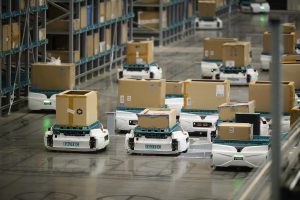

Instead of bespoke builds, Exotec created a standardised and scalable architecture that could be adapted by adjusting robot numbers and storage capacity.

Each site operates with between 150 and 200 robots, supports up to 125,000 storage locations and can process as many as 200,000 items per day while handling up to 4,000 order lines per hour.

That standardisation allowed Exotec to move at pace. “We delivered seven warehouses… and between the go-live of the latest warehouse, it was four months,” Moulin says, describing how teams moved from one site to the next in rapid succession.

For him, the shift marks a broader industry change. “That’s really a first in our industry, to kind of productise the warehouse… and then replicate it.”

Performance gains reshape warehouse operations

The operational gains are significant, both in efficiency and workforce impact.

“In terms of density, the warehouse went from 17,000 square metres to 5,000 square metres, more than divided by three,” Moulin says.

Throughput has also increased sharply. “The throughput of the warehouse is multiplied by two… you can do twice as many orders than before.”

Picking speeds have risen by 60 percent, while the retailer’s ability to replenish stores has also doubled. The impact on warehouse staff is particularly striking.

“At the Northampton site, a picker would walk 10 kilometres per day… now they walk just one kilometre per day.”

This reflects a wider industry challenge. Labour shortages remain persistent across logistics, with high turnover and difficulty attracting workers.


“Customers don’t find the people to do the job,” Moulin says. “They spend their time hunting for warehouse workers… and then they leave after a few weeks.”

Automation, he argues, is not just about efficiency but retention. “It’s critical that you give them good working conditions… people expect much more from their job than working 10 kilometres a day.”

The impact is already visible, with workplace incidents linked to order preparation halving and employees increasingly moving into higher-skilled roles.

From warehouses to networks

Beyond performance, the bigger shift lies in how retailers think about their supply chains.

Moulin is direct about the inefficiencies of traditional warehouse design. “We are an industry that has been used to bespoke machines… and bespoke warehouses each time,” he says. “It works, but it causes a lot of inefficiencies.”

Fragmentation creates hidden risks. Knowledge can be lost when teams change. Staff cannot easily move between sites. Retailers struggle to reroute supply or rebalance operations.

“If each of your warehouses is different… you lose the big picture,” he says. Standardisation, by contrast, creates a connected network.

“You can exchange people, you can exchange robots… you can solve a problem for everybody at the same time.”

Decathlon has rolled out a new multi-site automation programme, covering seven logistics centres across Europe as the retailer looks to standardise and scale its supply chain operations.

That thinking is shaping how Exotec now approaches new clients. “Let’s not talk about your warehouse. Let’s talk about your network,” Moulin says. “Tell me about your stores… how you deliver them… can we find a common pattern?”

The model also introduces new flexibility at scale. Robots can be moved between countries to support peak demand, while sites can be expanded incrementally as volumes grow.

For Decathlon, the transformation has been significant. “We were looking for a partner to support our logistics network rationalisation project,” said head of logistics automation Jérôme Saillour.

“In five years, we have profoundly transformed the workplace experience within our warehouses and written the next chapter of logistics at Decathlon.”

For Exotec, the project signals a broader evolution in the role of automation.“As intralogistics has become a strategic priority for our clients, we now create value throughout the entire warehouse,” Moulin says.

“With the Skyfleet program, we have demonstrated our ability to orchestrate multi-site deployments.”

Click here to sign up to Retail Gazette‘s free daily email newsletter

Feature ArticlesInsightSupply Chain

Leave a Reply

Your email address will not be published. Required fields are marked *

Fill out this field
Fill out this field
Please enter a valid email address.

‘We productised the warehouse’: Inside Decathlon’s Europe-wide logistics overhaul

Decathlon

As retailers grapple with rising costs, labour shortages and increasingly complex supply chains, automation has shifted from what was previously considered a competitive edge, to an absolute necessity.

Now, Decathlon is scaling that shift across Europe, rolling out a seven-site robotics programme with Exotec across the UK, France, Portugal, Italy and Germany.

Retail Gazette caught up with Exotec co-founder and CEO Romain Moulin to understand what the rollout means in practice and why he believes the industry needs to rethink how warehouses are built.

‘We productised the warehouse’

For Moulin, the starting point was not technology, but a bottleneck.

Decathlon, he says, “were struggling to deliver the throughput necessary from their warehouse,” while also needing greater flexibility and faster deployment.

Crucially, the retailer could not wait for traditional timelines. “They said… ‘I cannot wait [to] do one project every 18 months’… they could not wait 14 years to do seven warehouses.”

The solution was to fundamentally rethink the model. “What we built with them was really a warehouse pattern that we could replicate,” Moulin explains. “All of your warehouses will have the same way of working, the same features, the same software.”


Instead of bespoke builds, Exotec created a standardised and scalable architecture that could be adapted by adjusting robot numbers and storage capacity.

Each site operates with between 150 and 200 robots, supports up to 125,000 storage locations and can process as many as 200,000 items per day while handling up to 4,000 order lines per hour.

That standardisation allowed Exotec to move at pace. “We delivered seven warehouses… and between the go-live of the latest warehouse, it was four months,” Moulin says, describing how teams moved from one site to the next in rapid succession.

For him, the shift marks a broader industry change. “That’s really a first in our industry, to kind of productise the warehouse… and then replicate it.”

Performance gains reshape warehouse operations

The operational gains are significant, both in efficiency and workforce impact.

“In terms of density, the warehouse went from 17,000 square metres to 5,000 square metres, more than divided by three,” Moulin says.

Throughput has also increased sharply. “The throughput of the warehouse is multiplied by two… you can do twice as many orders than before.”

Picking speeds have risen by 60 percent, while the retailer’s ability to replenish stores has also doubled. The impact on warehouse staff is particularly striking.

“At the Northampton site, a picker would walk 10 kilometres per day… now they walk just one kilometre per day.”

This reflects a wider industry challenge. Labour shortages remain persistent across logistics, with high turnover and difficulty attracting workers.


“Customers don’t find the people to do the job,” Moulin says. “They spend their time hunting for warehouse workers… and then they leave after a few weeks.”

Automation, he argues, is not just about efficiency but retention. “It’s critical that you give them good working conditions… people expect much more from their job than working 10 kilometres a day.”

The impact is already visible, with workplace incidents linked to order preparation halving and employees increasingly moving into higher-skilled roles.

From warehouses to networks

Beyond performance, the bigger shift lies in how retailers think about their supply chains.

Moulin is direct about the inefficiencies of traditional warehouse design. “We are an industry that has been used to bespoke machines… and bespoke warehouses each time,” he says. “It works, but it causes a lot of inefficiencies.”

Fragmentation creates hidden risks. Knowledge can be lost when teams change. Staff cannot easily move between sites. Retailers struggle to reroute supply or rebalance operations.

“If each of your warehouses is different… you lose the big picture,” he says. Standardisation, by contrast, creates a connected network.

“You can exchange people, you can exchange robots… you can solve a problem for everybody at the same time.”

Decathlon has rolled out a new multi-site automation programme, covering seven logistics centres across Europe as the retailer looks to standardise and scale its supply chain operations.

That thinking is shaping how Exotec now approaches new clients. “Let’s not talk about your warehouse. Let’s talk about your network,” Moulin says. “Tell me about your stores… how you deliver them… can we find a common pattern?”

The model also introduces new flexibility at scale. Robots can be moved between countries to support peak demand, while sites can be expanded incrementally as volumes grow.

For Decathlon, the transformation has been significant. “We were looking for a partner to support our logistics network rationalisation project,” said head of logistics automation Jérôme Saillour.

“In five years, we have profoundly transformed the workplace experience within our warehouses and written the next chapter of logistics at Decathlon.”

For Exotec, the project signals a broader evolution in the role of automation.“As intralogistics has become a strategic priority for our clients, we now create value throughout the entire warehouse,” Moulin says.

“With the Skyfleet program, we have demonstrated our ability to orchestrate multi-site deployments.”

Click here to sign up to Retail Gazette‘s free daily email newsletter

Social


SUBSCRIBE TO OUR DAILY NEWSLETTER

  • This field is for validation purposes and should be left unchanged.
Feature ArticlesInsightSupply Chain

Leave a Reply

Your email address will not be published. Required fields are marked *

Fill out this field
Fill out this field
Please enter a valid email address.

RELATED STORIES

Latest Feature


Menu


Close popup

Please enter the verification code sent to your email: