

Birkenstock is allegedly falling out of favour with investors amid growing doubts that it can scale into a global luxury powerhouse.
The footwear brand, which listed on the New York Stock Exchange in 2023, had pitched itself as a 250-year-old sandal maker reborn as a modern luxury name.
However, three years on from its richly valued IPO, a sharp fall in its market value suggests investors are reassessing whether Birkenstock has the breadth, margins or mass appeal needed to sit alongside luxury giants such as LVMH.
Concerns intensified last week after Birkenstock reported slower quarterly growth and declined to raise its annual sales outlook, citing US tariffs and the conflict in the Middle East.
Shares fell more than 14 per cent to a record low of $32.44, leaving the business with a market capitalisation almost 38 per cent below the $9.3bn valuation it achieved at IPO.
The brand went public shortly after its famous two-strap sandal made a high-profile appearance in Greta Gerwig’s Barbie, which helped fuel a surge in global demand.
However, analysts now suggest Birkenstock sits in an awkward position between luxury and mass-market footwear. It has built a premium image by tightly controlling distribution and limiting discounting, but lacks the scale and product range of the world’s largest luxury houses.
“Investor expectations likely became inflated once the brand was valued more like a luxury fashion company than a footwear company,” said Keith Fraley, an assistant professor at the Fashion Institute of Technology in New York.
Fraley said the challenge for Birkenstock was maintaining exclusivity while continuing to grow globally.
That tension has become increasingly central to the business under chief executive Oliver Reichert, the former journalist who became Birkenstock’s first leader from outside its founding family.
Private equity firm L Catterton, which is backed by LVMH, continues to hold a majority stake in the company.
Birkenstock produces most of its shoes in Germany, reinforcing its premium credentials but leaving it exposed to higher production costs than rivals that manufacture in Asia.
At the same time, consumer demand is showing signs of strain. The brand has been able to push through price increases among wealthier shoppers, but more price-sensitive customers are pulling back as higher living costs weigh on discretionary spending.
Those pressures were visible in its latest quarter, with margins squeezed by a weaker dollar against the euro and a tariff burden that doubled to 20 per cent, hitting profitability in its largest market, the US.
Birkenstock’s adjusted EBITDA margin declined by 270 basis points in the quarter, while the company warned those pressures would continue to weigh on margins this year.
Despite attempts to expand beyond its core sandals into clogs, boots and trainers, analysts and brand experts said Birkenstock’s contoured cork footbed remains central to the brand’s identity and is still largely associated with summer footwear.
Investors are now recalibrating expectations, moving from the idea of Birkenstock as a high-growth luxury contender to a steady, more constrained consumer brand.
“Fashion markets eventually ask the same question, is this timeless or did everyone who wanted in buy enough?” said Michael Ashley Schulman, a partner at Cerity Partners.
That shift is also reflected in Birkenstock’s valuation. Its shares now trade at around 13 times forward earnings, close to the industry average and a sharp comedown from the premium it once commanded when the stock peaked at $123.17.
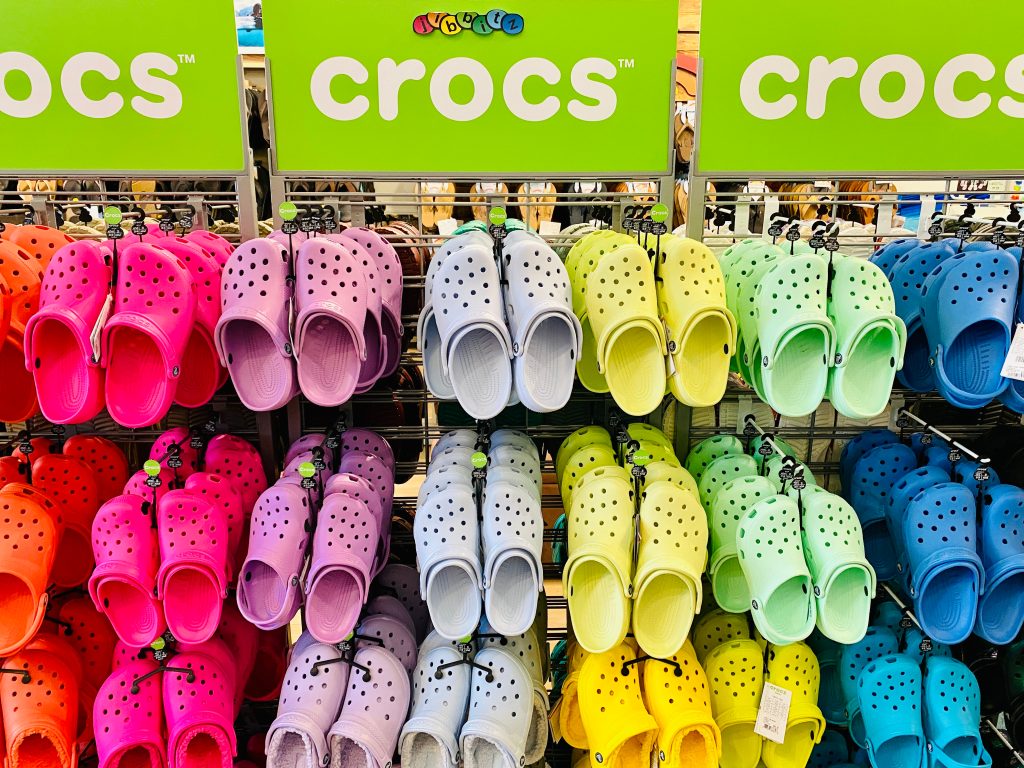
By contrast, Crocs, Birkenstock’s closest rival, has avoided a similar sell-off in part because it already trades at mass-market footwear multiples. The company trades at around seven times its next 12 months’ earnings and delivers margins above 20 per cent.
Brand experts warned that Birkenstock now faces a delicate balancing act as it looks to drive growth without undermining the premium positioning that has helped set it apart.
“If Birkenstock chases volume by opening too many wholesale doors or relying on promotions, they will lose the luxury premium they’ve spent decades building,” said Eric Tsytsylin, a brand strategy partner at global brand consultancy Lippincott.
Click here to sign up to Retail Gazette‘s free daily email newsletter